A silver mohar can tell the story of a journey to Tibet. A tiger on a banknote can outlast a political system. In Nepal, money preserves the memory of workshops, rulers and landscapes.
The modern rupee dates from 1932, but its history begins much earlier. Following coins and banknotes reveals how a valley of royal cities, a unified kingdom and a republic gave successive forms to trust.
01 · Before the rupee: Licchavi copper
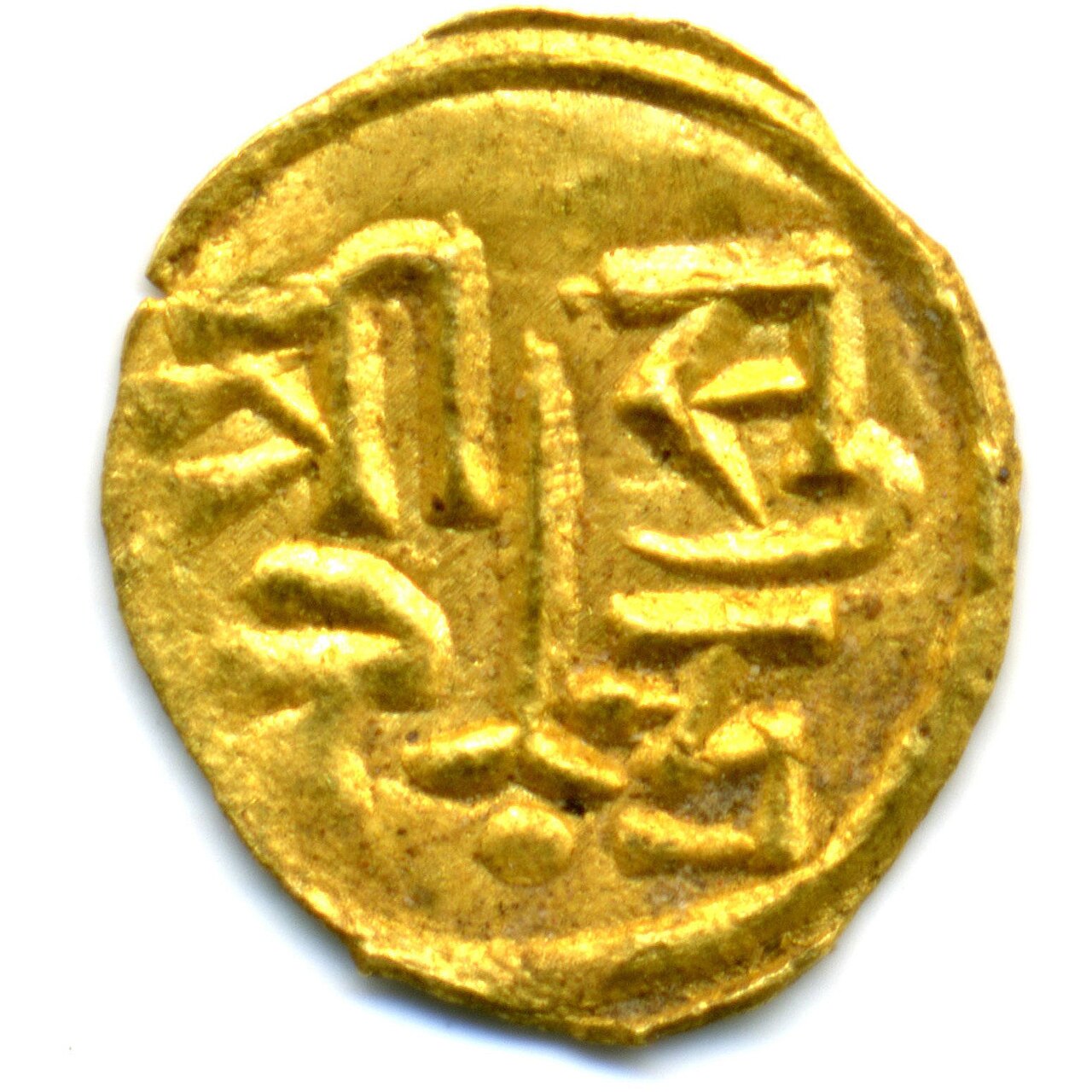
Long before royal portraits appeared on paper, small copper coins carried the names and beliefs of rulers in the Kathmandu Valley. The types known as Mananka, Gunanka and Pashupati, alongside coins of Amshuvarman and Jishnugupta, belong to the Licchavi world of the first millennium CE. Lions, divine figures and inscriptions already connected payment with political and religious authority.
The Mananka is traditionally associated with Manadeva, a fifth-century king. That attribution should be distinguished from the dating of an individual specimen: an undated coin cannot by itself establish its year of manufacture. Earlier scholars offered differing interpretations. The secure starting point is an ancient local coinage whose types and inscriptions can be studied through archaeological finds.
These copper pieces were not an early version of the Nepalese rupee. Calling them rupees would erase changes in units, rulers and areas of circulation. They introduce a longer story: communities learning to recognise a weight, a mark and an authority in a piece of metal.
Department of Archaeology, Ancient Nepal 154 · Regmi Research Series, vol. 6 — Licchavi coinage
02 · Three royal courts and the art of silver
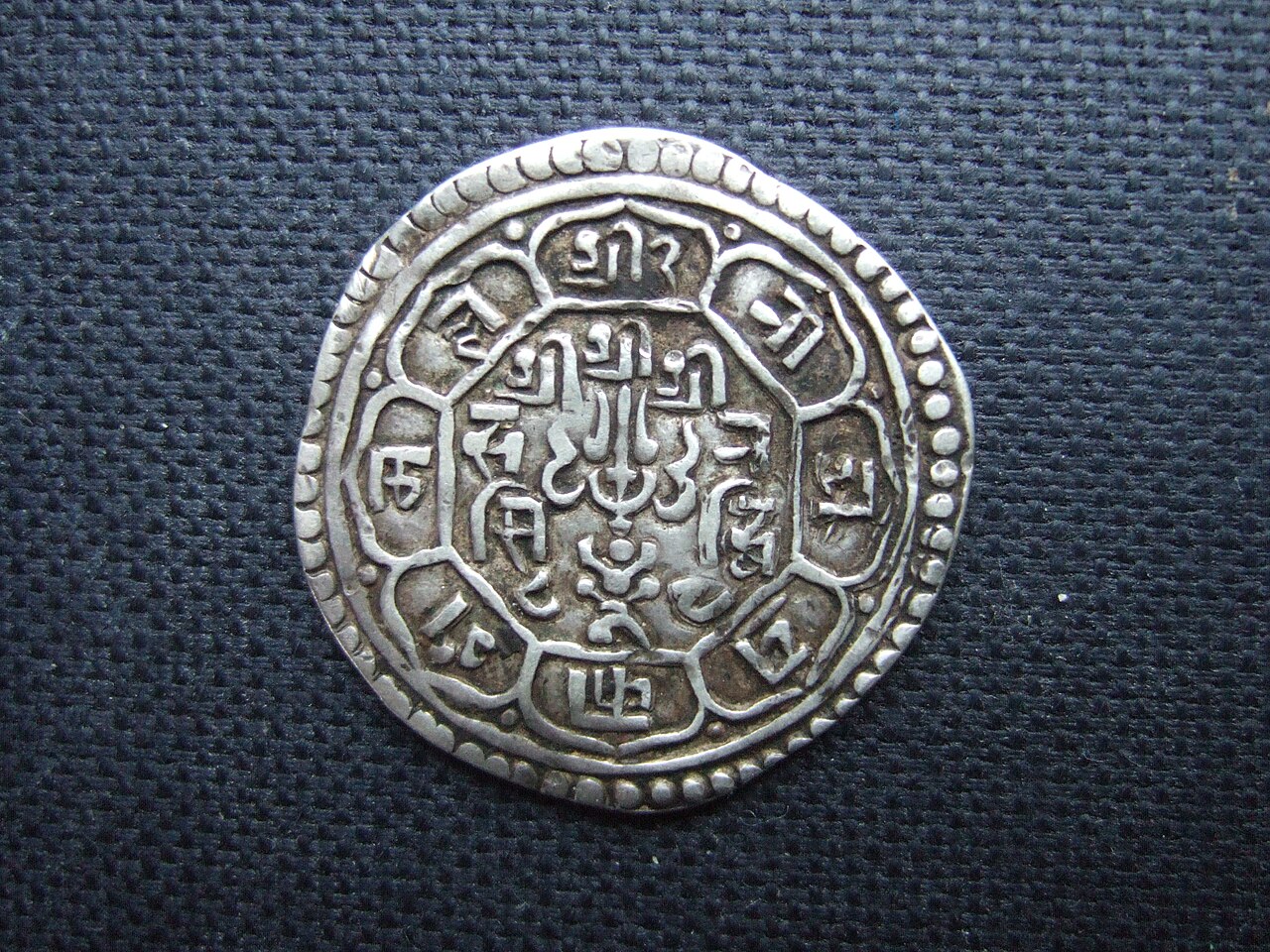
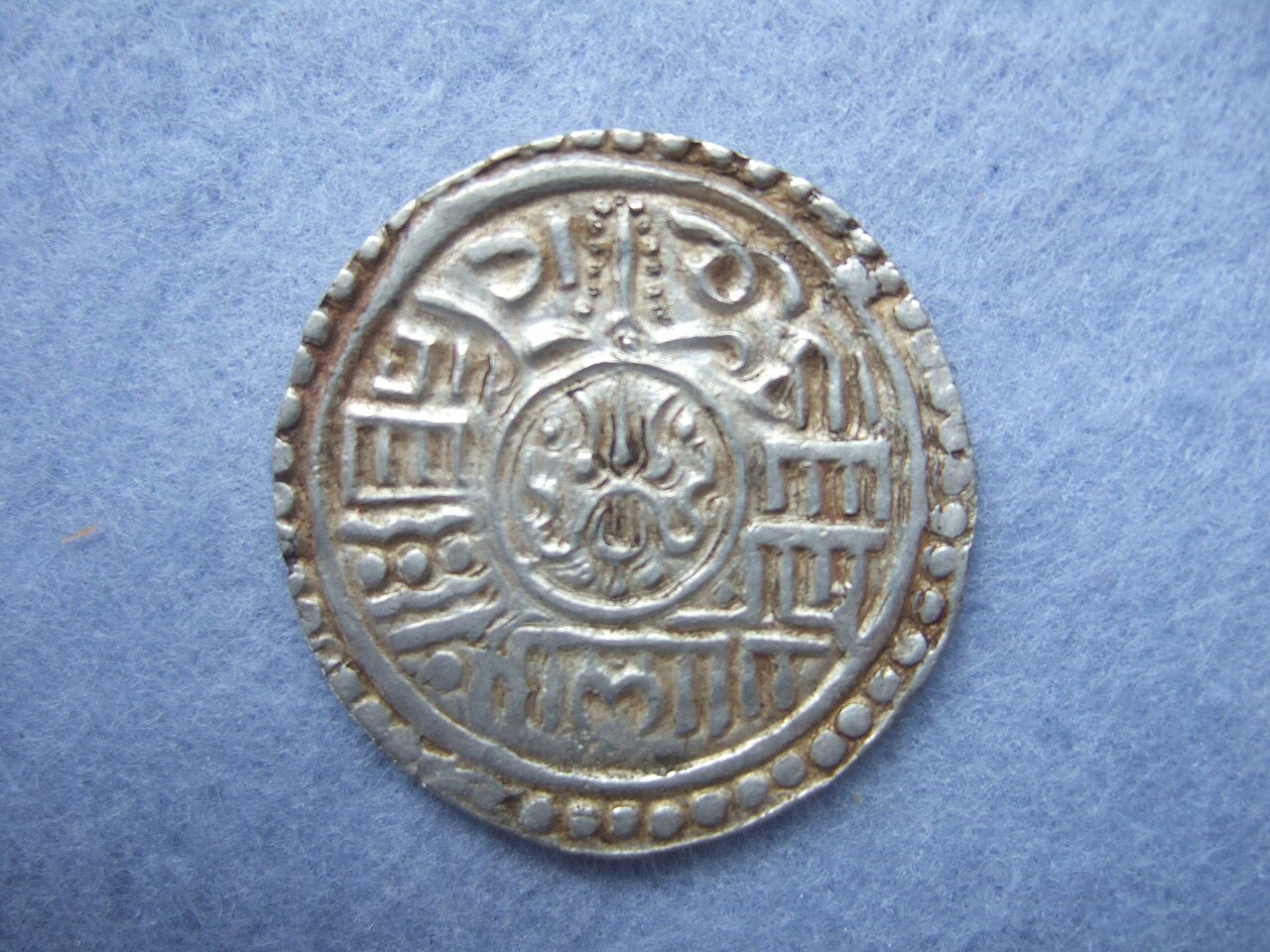
Under the Malla kingdoms, the valley became a remarkable centre of monetary craftsmanship. Kathmandu, Patan — now Lalitpur — and Bhaktapur, also called Bhadgaon, maintained their own courts, workshops and issues. Silver mohars of the sixteenth to eighteenth centuries give this political landscape a form that fits in the hand.
The designs often develop outwards from a centre through petals, compartments and lettering. Tridents, swords and auspicious emblems were more than interchangeable decoration: they belonged to the valley’s political and religious vocabulary. One Kathmandu mohar dated 1746 in the British Museum weighs 5.19 grams; its record identifies a trident, the eight auspicious symbols and a sword within a wreath.
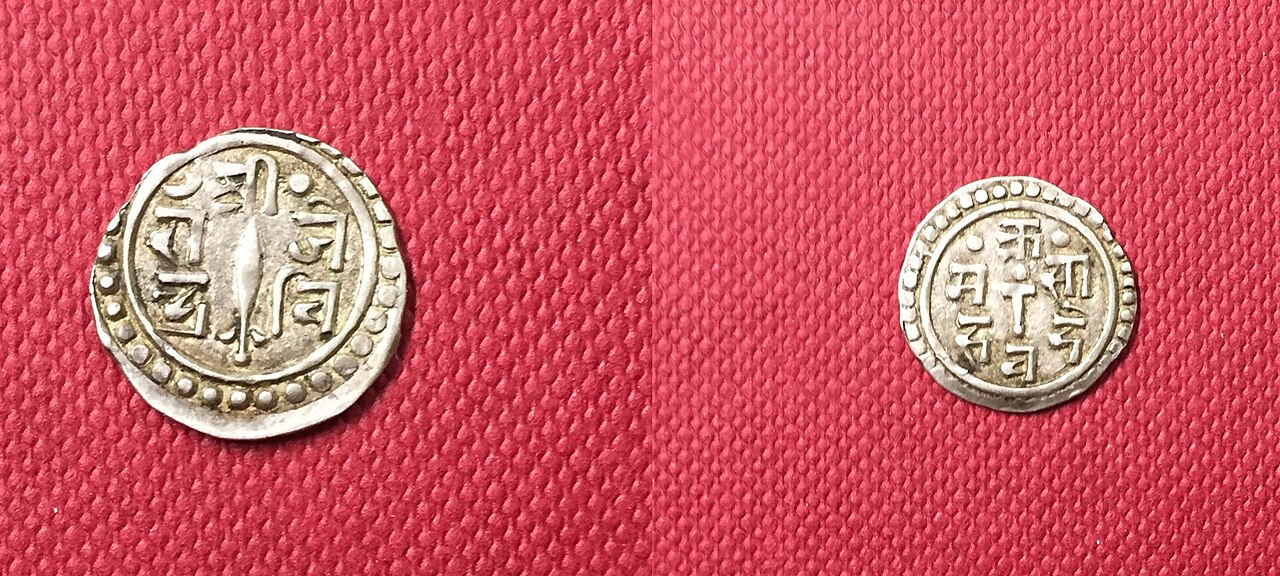
A coin is also a workshop’s signature. Royal names and dates distinguish issues that initially look alike. In the photographs here, uneven blanks, worn relief and the arrangement of letters invite attention to the engraver’s work rather than a portrait. Sovereignty could be expressed through writing.
British Museum — mohar, Kathmandu, 1746

03 · Silver across the Himalaya
The mountains did not stop these coins’ history: they shaped its routes. Merchants connected the valley with Tibet and the plains of the subcontinent. Nepalese workshops struck silver for Tibetan circulation. Bullion and finished coins travelled, while the income from minting gave rulers a practical reason to protect the trade.
The arrangement depended on trust in fineness, the proportion of silver in a coin. When some Malla issues were debased by reducing that proportion, a difficult question followed: should a new fine-silver coin exchange at the same value as an older piece containing less silver? This was no argument over terminology. It determined the value of a payment and who would bear the loss when coins were replaced.
Prithvi Narayan Shah, ruler of Gorkha, also sought control of this trade. His conquest of the valley in 1768–1769 brought the former capitals under the Shah dynasty, but did not automatically settle the status of money already circulating in Tibet. Monetary disputes formed part of the tensions that followed. They should not be treated as the sole cause of a complex diplomatic and military relationship.
Regmi Research Series, May 1973 — Nepal–Tibet coinage

04 · From Shah mohars to the rupee of 1932
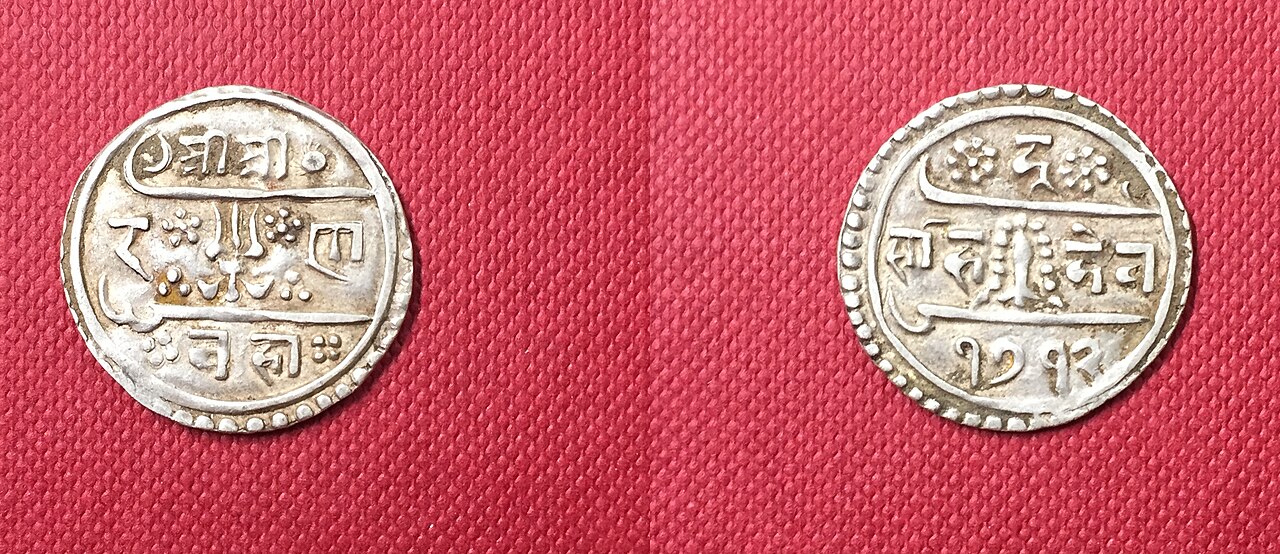
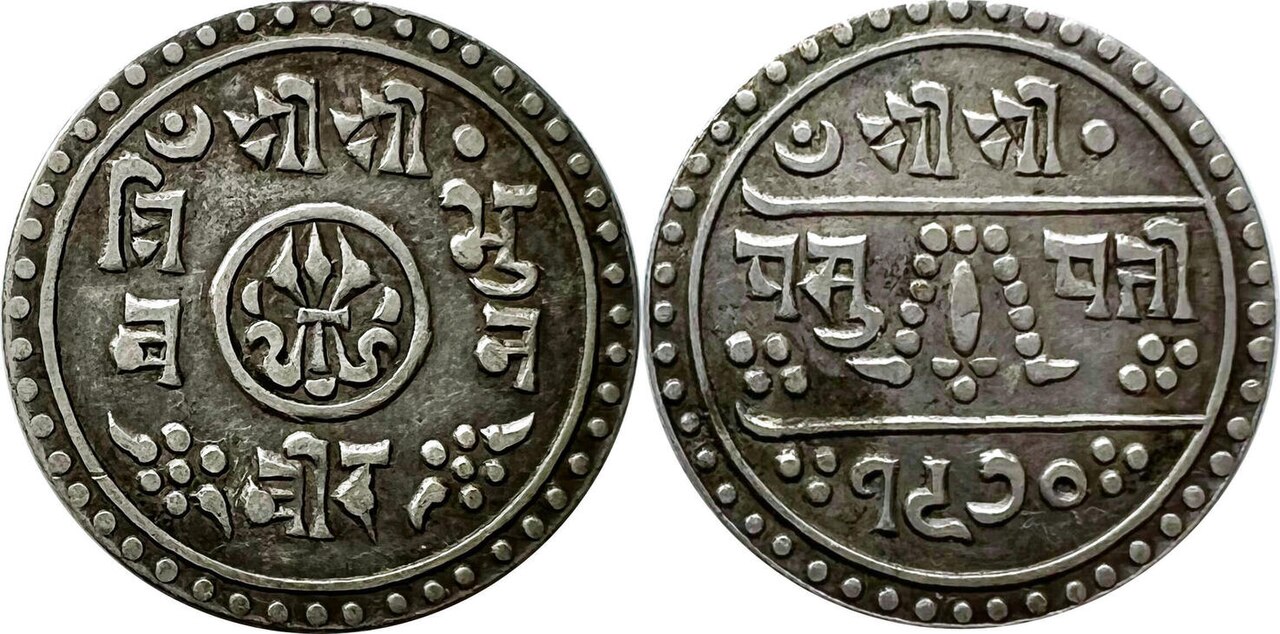
Unification did not immediately end the mohar. Shah rulers continued to issue multiples, fractions and copper coins for smaller payments. The quarter mohar of Tribhuvan shown here still belongs to this world in the early twentieth century. At roughly 1.40 grams and 16 millimetres across, its lettering and emblems are a miniature composition.
The key date of 1932 marks the introduction of the modern rupee at two mohars to one rupee, under Tribhuvan. A Mint Department was also organised that year. The reform therefore involved both manufacturing and administration; it belongs neither to the conquest of 1769 nor to a sudden nineteenth-century invention of Nepalese money.
Older language nevertheless survived. Mohru or moru appears in the Nepalese wording of early banknotes. It should be distinguished from the earlier metal mohar: similar names do not necessarily identify the same unit. The issue, its date and its face value provide the safest way to read the object.
Regmi Research Series — Mint Department and coinage


05 · 1945: the Treasury puts trust on paper
In September 1945, the Sadar Muluki Khana, or Central Treasury, issued Nepal’s first banknotes in denominations of 5, 10 and 100 rupees. Nepal Rastra Bank did not yet exist. These notes carried Tribhuvan’s portrait and the signature of a khajanchee, the head of the Treasury. NRB’s catalogue identifies Janak Raj Pandit as the signatory of this first issue.
The five-rupee note combines the royal portrait with dense decoration, a large clear watermark area and a tiger among vegetation on the reverse. The ten shows Guheshwari temple; the hundred depicts Pashupatinath on the front and a rhinoceros on the back. Portrait, sacred architecture and wildlife each contribute a different element of identity.
Moving from metal to paper changed how the object was judged. A silver coin contained a valuable material; a banknote required confidence in its issuer, its identifying marks and other people’s willingness to accept it. Signature, numbering and watermark made the promise visible. Ornamental borders and intricate linework complicated copying while giving the note its character.
The first issues did not reach the entire country at once. Circulation was initially limited, particularly to the valley and selected hill areas. The history of paper money must distinguish its first issue from its gradual adoption. A birthday cannot by itself describe a country’s payment habits.
NRB — Notes and Coins of Nepal, 2006 · NRB — Sixty Years of Nepal Rastra Bank, 2018, chapter 7
06 · The rhinoceros before the republic
The hundred-rupee note of 1945, described in NRB’s catalogue, allows both sides of one visual programme to be compared. A king and a sanctuary occupy one face; an animal in vegetation occupies the other. The rhinoceros did not begin its monetary career on republican banknotes. It was already part of royal paper money.
This continuity challenges an easy division between an entirely royal currency before 2008 and a wholly new one afterwards. An issue can abandon a portrait while retaining an animal, a temple or a way of arranging space. Banknotes bring together symbols that change at different speeds.
The catalogue also shows a large watermark area. The apparent blank space serves a security function in the paper. A digital reproduction records the printed design, but cannot convey the paper’s feel or thickness, or all the effects seen against the light. A photograph documents an object without replacing it.
07 · 1956–1960: building a common currency
Nepal Rastra Bank opened on 26 April 1956 under the 1955 Act, with Himalaya Shumsher as its first governor. One of its central tasks was to extend the reach of Nepalese money in a country where Indian rupees still played an important role.
On 19 February 1960 the Bank issued its first notes, in denominations of 1, 5, 10 and 100 rupees. It took over a responsibility previously exercised by the Treasury. A new signature and issuer’s name mattered as much as a portrait: behind the familiar word “rupee”, an institution was assuming responsibility for issuance.
A national currency does not become everyday money through legislation alone. It needs counters, available banknotes, opportunities to exchange them and public payments that make them useful. Building this network helps explain why Nepal’s monetary history is also a history of distance and physical distribution.
A banknote is light, but delivering it remains a material operation. Notes must be distributed, worn examples returned, and reserves counted and stored. Between issuer and place of payment, trust depends on an organisation that cannot be seen in the engraving.
NRB — Sixty Years of Nepal Rastra Bank, 2018, chapter 7 · NRB — objectives and responsibilities
08 · Two rupees with connected histories
The peg to the Indian rupee began in April 1960. Its level was subsequently revised several times; the ratio of 160 Nepalese rupees to 100 Indian rupees was set in February 1993. The beginning of the exchange-rate regime and the later choice of its level are therefore separate events.
Consider a simple accounting example: at a central parity of 1.60, ten Indian rupees correspond to sixteen Nepalese rupees. This institutional relationship does not make the currencies identical. They retain different designs and issuers.
The arrangement provides a stable reference for bilateral transactions. It also creates a constraint: the central bank cannot allow the Nepalese rupee to move freely against its anchor while promising to maintain the ratio. Stability between two currencies does not mean that every domestic price stays constant.
NRB nevertheless retains central-bank responsibilities, including monetary policy, financial oversight and payment systems. Describing it as merely an Indian “currency board” would erase those functions. This is the history of an institutional balance between national money and an enduring regional relationship.
NRB — 63rd anniversary publication, 2018, pp. 135–136 · NRB — objectives and responsibilities
09 · From a royal face to Mount Everest
Portraits of Tribhuvan, Mahendra, Birendra and Gyanendra mark successive phases of royal banknotes. A portrait can help locate an issue in time, but it is only a starting point: signatures, watermarks and design variants often narrow the period further. A note is not necessarily dated in the same way as a book.
In September 2007 a 500-rupee note replaced Gyanendra’s portrait with Mount Everest. This preceded the formal abolition of the monarchy in May 2008. Here currency imagery anticipated constitutional change. Everest, called Sagarmatha in Nepali, shifted the emphasis from the ruler’s person to a national landscape.
A material detail made the transition visible within the paper itself. The earliest notes of this type used paper still bearing the king’s portrait watermark, with a rhododendron overprinted over that area. The object therefore preserved traces of two successive political programmes. Surface design and security paper had changed at different moments.
Mountains, monuments and wildlife retained an important place in republican designs. This was a rearrangement of symbols rather than an abandonment of heritage. The country could now represent itself without requiring the monarch’s face to accompany each payment.
Banknote News — 500 rupees, issue of 27 September 2007 · NRB — Notes and Coins of Nepal, 2006
10 · Reading Nepalese money
A date, a signature, an animal and a few characters open several paths into a coin or note. Devanagari numerals use the decimal system: ० १ २ ३ ४ ५ ६ ७ ८ ९ correspond to 0 1 2 3 4 5 6 7 8 9. Reading the digits, however, is not the same as converting a date.
Bhupatindra’s mohar is dated 816 in the Nepal Sambat era, identified as 1696 for this specimen. Tribhuvan’s quarter mohar bears 1970 in the Vikram Samvat era, corresponding to 1913. Applying one offset to both would produce a mistake. The calendar, its new year and the issue’s context matter as much as the engraved number.
On paper money, the issuer’s name distinguishes Treasury from central bank. The signature identifies a responsible official, while the value may be repeated in different scripts. The front often gives prominence to authority or national landmarks; the reverse provides another space for representation. Both sides should be read together.
Security features add another layer. NRB’s guides explain, for particular issues, the rhododendron watermark, see-through registration, security threads, raised inks and effects that change when a note is tilted. These belong to specific series: a feature of one 500-rupee issue should not be attributed to every historical banknote.
NRB — Bank Notes Security Features

11 · The workshop behind the money
The word taksar, associated with the mint, is a reminder that money is manufactured before it becomes an abstraction. Preparing metal, checking its quality, making dies and producing legible relief are separate operations. An error in weight or fineness could once undermine confidence in an entire issue.
NRB’s Mint Division at Babarmahal retains responsibilities for coins, medals and precious metals. Its official description distinguishes minting and selling gold and commemorative coins, checking metals and managing the circulation of one- and two-rupee coins.
Issuance should be distinguished from physical manufacture. A central bank can define a currency and organise its circulation while using specialist suppliers. The 1945 banknotes were printed by India Security Press at Nashik. Sovereign money can therefore be made abroad: the printer’s location does not determine the currency’s nationality.
Commemorative coins have a particular purpose as well. They may celebrate an institution, an anniversary or an animal species, using metals and denominations that distinguish them from everyday change. Treating them merely as expensive versions of small circulating coins would miss their role as objects of collection and remembrance.
From Licchavi copper through mohars to Treasury paper and republican issues, each object asks a practical question: who guarantees this payment? Royal names, metal, signatures and the central bank have offered different answers. That succession of guarantees, preserved in coins and notes, gives the history of the Nepalese rupee its depth.
NRB — Mint Division · NRB — Notes and Coins of Nepal, 2006

The story at a glance
| Date | Event |
|---|---|
| 5th–7th c. | Licchavi copper coinage |
| 16th–18th c. | Mohars and Malla royal workshops |
| 1768–1769 | Prithvi Narayan Shah conquers the valley |
| 1932 | Modern rupee and organisation of the Mint Department |
| 1945 | First Treasury banknotes |
| 1956 | Nepal Rastra Bank established |
| 1960 | First NRB banknotes; peg to INR begins |
| 1983 | Mint Department transferred to NRB |
| 1993 | Parity set at NPR 160 per INR 100 |
| 2007–2008 | Everest replaces the royal portrait; republic proclaimed |
Sources and credits
Research checked on 15 October 2026. Source links require an internet connection; the article and its illustrations can be read offline.
- Department of Archaeology, Ancient Nepal 154
- Regmi Research Series, vol. 6 — Licchavi coinage
- British Museum — mohar, Kathmandu, 1746
- Regmi Research Series, May 1973 — Nepal–Tibet coinage
- NRB — Notes and Coins of Nepal, 2006
- NRB — Sixty Years of Nepal Rastra Bank, 2018, chapter 7
- NRB — 63rd anniversary publication, 2018, pp. 135–136
- NRB — objectives and responsibilities
- NRB — Mint Division
- NRB — Bank Notes Security Features
- Banknote News — 500 rupees, issue of 27 September 2007
- Regmi Research Series — Mint Department and coinage
Photographs and reproductions are stored locally. Illustrations show mohars and dams predating the modern rupee. Banknotes are discussed without reproduction: section 61(2) of the Nepal Rastra Bank Act provides for prior authorisation to reproduce rupee-denominated currency. No such authorisation has been established for this dossier. Detailed credits and conditions are recorded in the manifest.