An irregular silver fragment, a calligraphic rupee, Ashoka’s lions, a stepwell or a Mars spacecraft: Indian money places centuries of history in the palm of a hand. Its name connects the markets of Sher Shah’s age with phone payments, yet its forms and the authorities it represents have changed profoundly.
From the middle of the first millennium BCE to the transformations of the twenty-first century.
Before the rupee: metals, marks and kingdoms
The monetary history of the subcontinent begins long before British rule or the rupee. In ancient India, pieces of silver were stamped with separate marks: a sun, animals or geometric shapes. Their uneven outlines differ from the perfectly round discs familiar today. What mattered first was the metal, its weight and the marks by which it could be recognised.
The earliest chronology remains debated. A cautious account places the development of punch-marked coinage around the middle of the first millennium BCE, before and during Mauryan expansion. Assigning every issue the same starting date, or calling these objects “rupees”, would obscure their variety. The RBI museum places them within a history of successive authorities and monetary traditions. [1]
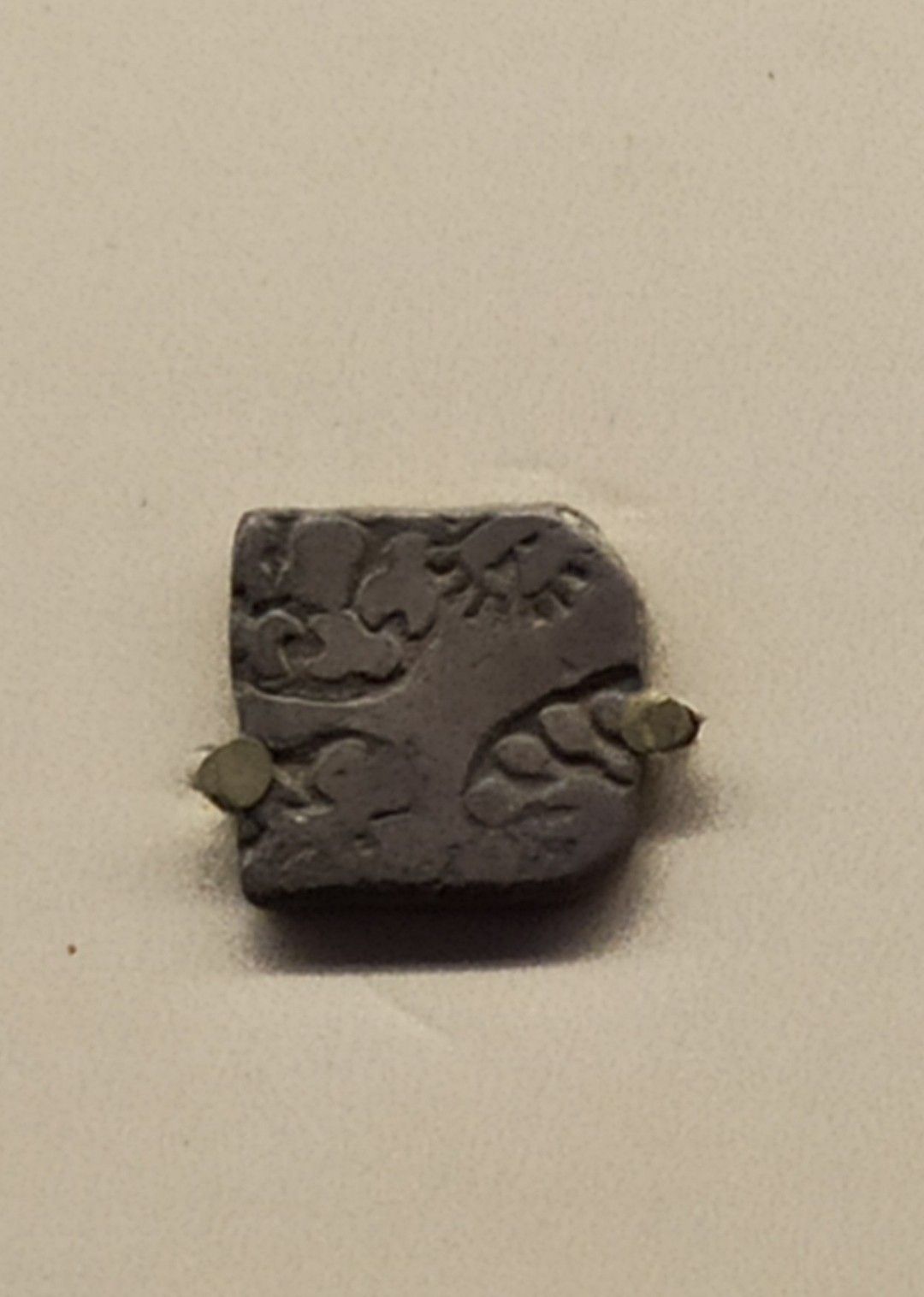

Later centuries expanded this visual language. Indo-Greek rulers used portraits and bilingual inscriptions; Kushan coins depicted deities from several traditions; Gupta gold coins showed rulers in ceremonial poses. A coin could communicate authority, belief and cultural connections while also serving exchange. Copper and other payment media met needs different from those of high-value gold pieces. [1]
There was no single currency already covering the territory of modern India. Political boundaries, trading networks and payment customs varied. The future rupee emerged from this much older world of metals, weights and skilled manufacture.
Sher Shah and the silver coin behind the name
The word “rupee” is related to Sanskrit rūpya, associated with worked or coined silver. An old word does not, however, establish that an unchanged currency existed throughout the centuries. The decisive landmark is the rupiya of Sher Shah Suri, an Afghan ruler who governed from Delhi between 1540 and 1545. The RBI describes his silver coin of 178 grains, approximately 11.5 grams, as the precursor of the modern rupee. [2]
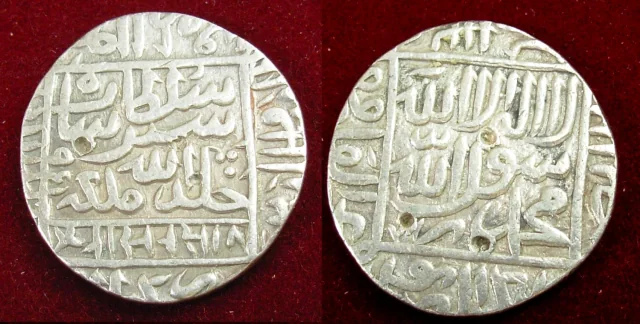

The coin belonged to a monetary system linking gold, silver and copper. Standardisation made taxes and payments easier to reckon: a recognised silver unit could be accepted beyond a single local market. It did not eliminate neighbouring currencies or differences in the quality of coins actually changing hands.
Sher Shah’s legacy was a lasting standard rather than “India’s first money”. His reign was short, yet the weight and name of his silver rupee survived dynastic changes. That material continuity helps explain why a modern currency can carry the memory of a sixteenth-century ruler. [2]
The Mughal rupee: reading an empire on a coin
The Mughals adopted and developed this inheritance. Under Akbar, who ruled from 1556 to 1605, money accompanied the consolidation of a large empire. The silver rupee circulated alongside the gold mohur and copper dam. Their relationships should not be treated as timeless conversion rates: metal prices and the circumstances of circulation mattered too. [2]
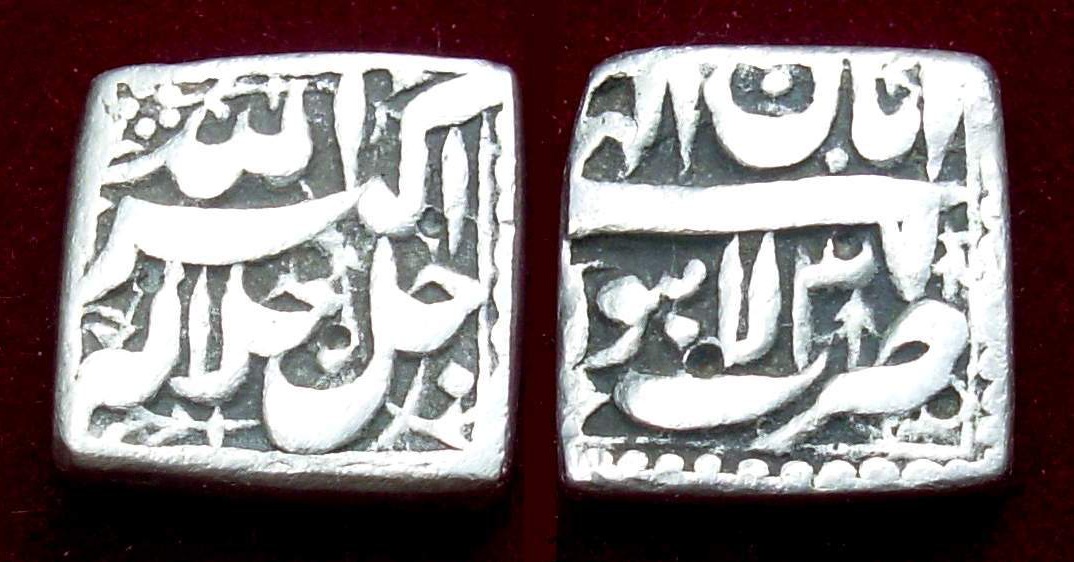

A Mughal rupee often introduces itself through writing. The ruler’s name and titles, a date, a mint name and religious or imperial formulas express authority. These details help specialists locate an issue; they also remind other readers that a portrait is not required to assert sovereignty. [2]
Differences between mints and reigns turn these coins into miniature archives. Reading them requires care with calendars, regnal years and dates expressed in different eras. A number on a coin is not automatically a Gregorian year. Here, objects are identified to the level supported by their collection records, without assigning a commercial provenance or an unverified mint.
As Mughal authority fragmented, regional powers continued to use related monetary forms, sometimes in the name of an emperor whose practical power had diminished. Familiar inscriptions could therefore conceal profound political change. The rupee remained a reference within a landscape of multiple currencies and authorities.
1835: the Company rupee and colonial standardisation
The East India Company entered an already organised monetary world. Its settlements did not immediately replace local practices. Bengal, Bombay and Madras initially retained different monetary arrangements. Standardisation gradually became an instrument for administering the territory under Company control. [3]
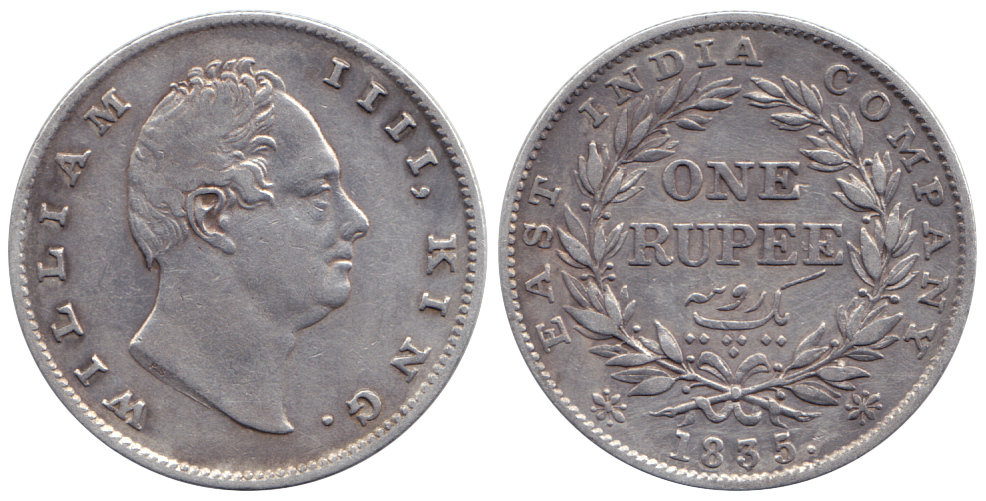

The Coinage Act of 1835 introduced uniform coinage in British India. William IV’s rupee combined the royal bust with a denomination written in English and Persian. The silver disc made a transfer of power visible: the rupee form continued while its declared sovereignty changed. Standardisation did not mean that every princely state immediately lost its own issues. [3]
The traditional accounting system is itself historical evidence: 1 rupee = 16 annas = 64 pice = 192 pies. Knowing these subdivisions makes an old invoice or the price of a small purchase intelligible. In this system, “pice” and “pie” describe different units; confusing them changes the amount. [4]
During the nineteenth century, the external value of a silver rupee also depended on the relationship between silver and gold. When the two metals moved differently, an unchanged rupee amount no longer represented the same sum in sterling. Closing the mints to the free coinage of silver in 1893 marked a turning point: the monetary regime moved away from simply turning silver brought to a mint into coins. [3]
From bank-issued paper to the Reserve Bank of India
Banks issued paper money in India long before the RBI existed. The Paper Currency Act of 1861 subsequently reserved note issue to the government. A banknote was an identifiable issuer’s printed promise, supported by signatures and controls; it was more than a lighter substitute for a metal coin. [5]
The one-rupee note appeared in 1917 amid the First World War and pressure on silver currency. On the early issues illustrated here, George V’s portrait and the image of a coin connect the paper to its metallic counterpart. These Government of India notes predate the central bank. [5]
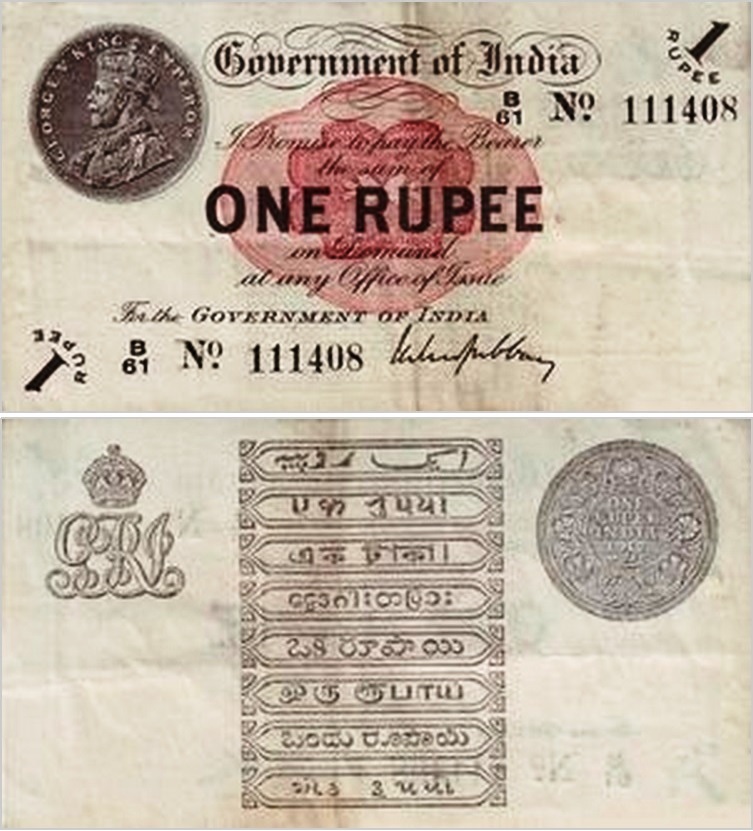

The Reserve Bank of India began operations on 1 April 1935 under the 1934 Act. Its own first banknotes followed in January 1938: the initial denomination was five rupees, bearing George VI’s portrait. Establishing a central bank and physically replacing currency were therefore separate stages. [6]
One distinctive arrangement survived changes of government. The one-rupee note is issued by the Government of India and signed by the Finance Secretary; RBI banknotes carry the Governor’s signature. Looking at a signature thus reveals different public responsibilities behind the same unit of account. Coins are also issued under government authority. [7]
1947–1950: new sovereignty, familiar money
Independence on 15 August 1947 did not replace every note and coin overnight. Retaining familiar money allowed payments to continue while institutions changed. The “frozen series” period shows how the material circulation of money could follow a different timetable from political declarations. [4]
Partition brought enormous human displacement and administrative difficulties. The RBI temporarily performed central banking functions for Pakistan until the end of June 1948; the State Bank of Pakistan opened on 1 July. This was a transitional arrangement, rather than a lasting jointly managed central bank. The RBI itself was nationalised on 1 January 1949. [6]
In 1949, the government introduced a new one-rupee note. The Lion Capital of Ashoka at Sarnath replaced the royal effigy as a sign of sovereignty. India became a republic on 26 January 1950; its first distinctively republican coin series was launched on 15 August that year. The monarch disappeared, giving way to the lions and Indian motifs. [8]


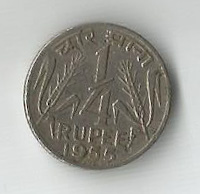

The rupee coin in the first series notably featured ears of grain. The visual language of money was changing: ancient symbols were adopted to represent a contemporary republic, while agriculture entered the everyday image of the nation. Yet the anna system remained. Changing the authority depicted on money and changing its subdivisions were different reforms. [4]
1957: learning to count in naye paise
On 1 April 1957, the rupee became divisible into one hundred naye paise, or “new paise”. The value of the rupee itself was unchanged. This was not a removal of zeros from household savings, but a replacement of the old arithmetic of annas, pice and pies with decimal subdivisions. From June 1964, the word naya was dropped from new issues. [4]
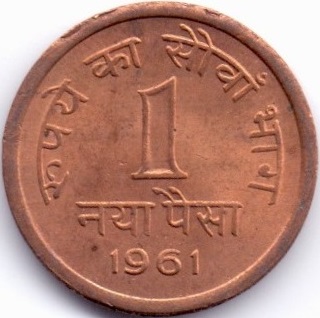

A simple calculation makes the change tangible. Four annas had represented a quarter rupee; they now corresponded to 25 new paise. One anna therefore equalled 6.25 new paise. An exact conversion did not always produce an amount payable with a single available small coin: this illustrates the practical adjustment that changing subdivisions required at a shop counter or in household accounts.
The shapes, sizes and metals of coins help users distinguish denominations. They also change with manufacturing costs and the demands of mass production. Moving from precious metal to base-metal alloys does not erase monetary value: that value rests on the issuing framework and acceptance of the currency rather than primarily on the material of the coin. [4]
The singular is paisa; the plural is paise. Preserving the Indian plural in historical names makes inscriptions easier to understand. Sometimes the history of money is hidden in a single word added to, and later removed from, a small coin.
1966 and 1991–1994: the rupee’s external value
The history of monetary objects intersects with exchange-rate decisions. On 6 June 1966, the rate moved from approximately 4.76 to 7.50 rupees per US dollar. The rupee’s dollar value fell by about 36.5%, while the rupee price of a dollar rose by roughly 57.6%. Both percentages describe the same adjustment from different starting points; treating them as interchangeable is a common mistake. [9]
The decision came amid external difficulties and import needs. It affected the cost of purchases abroad and the proceeds of exports without creating a new domestic unit. An existing one-rupee coin remained denominated in the same rupee; its relationship with other currencies had changed.
A balance-of-payments crisis in 1991 brought another turning point. Prime Minister P. V. Narasimha Rao’s government and Finance Minister Manmohan Singh embarked on reforms, with the RBI playing a central monetary role. Mobilising gold reserves and adjusting the exchange rate made the urgency visible. For businesses settling purchases abroad, foreign currency was no longer an abstract issue: obtaining it had become an immediate constraint. [10]
Exchange-rate adjustments on 1 and 3 July 1991 were followed in March 1992 by LERMS, a dual-rate system. Rates were unified around a foreign-exchange market in March 1993; current-account convertibility followed in August 1994. The latter did not mean unrestricted freedom for every capital movement. [10]
This sequence explains more than the phrase “the rupee became convertible”. It shows institutional change unfolding in stages, and why a note can keep its name while circulating within a profoundly altered monetary environment.
Making trust tangible: mints, paper and signatures
A national currency is also an industrial undertaking. SPMCIL’s mints in Mumbai, Kolkata, Hyderabad and Noida produce coins. Their traditions are not interchangeable: some continue long local histories, while others respond to the republic’s growing needs. [11]
Banknotes are printed at Nashik and Dewas by SPMCIL, and at Mysuru and Salboni by BRBNMPL, an RBI subsidiary. Nashik began producing notes in 1928. Building this capacity gives monetary sovereignty a material dimension: design, papermaking, printing, inspection and distribution are separate activities. [12]
Watermarks, raised printing, security threads and serial numbering connect a note’s appearance with its function. They help identify an issue and make counterfeiting harder. The visual appeal of a banknote is therefore inseparable from its manufacture. Photographs in this article do not replace the issuer’s authentication guides.
Commemorative coins add another function: preserving public memory. They mark people, anniversaries and institutions. Collector editions can differ from coins encountered in ordinary payments; a numismatic selling price is not an exchange value. Mint catalogues need to be read with that distinction in mind. [11]
From Ashoka’s lions to Gandhi: a nation in images
Ashoka’s Lion Capital placed the young republic within a history much older than colonial rule. Post-independence notes also developed a repertoire of animals, monuments and productive activities. These images were more than ornament: they offered ways of representing the country to its people. [8]
Gandhi appeared on commemorative notes in 1969, the centenary of his birth. The Mahatma Gandhi series launched in 1996 subsequently established his portrait as a shared feature. His first appearance on banknotes and the introduction of the series named after him are therefore distinct events. Ashoka’s emblem remained; the new portrait did not remove it from the currency’s visual language. [13]
The language panel offers another image of India. RBI notes state the denomination in fifteen languages within that panel, alongside Hindi and English elsewhere on the note. This makes visible a diversity that the international code INR cannot express on its own. Numerals and Devanagari characters contribute to this multilingual reading. [7]
The ₹ sign, designed by D. Udaya Kumar, was approved on 15 July 2010. It brings together references to the Devanagari letter “र” and the Latin R. Its adoption created neither a new rupee nor a new exchange parity: it gave Indian money a distinctive graphic signature. Other currencies called rupees retain their own histories and identities. [14]
2016: withdrawing notes, retaining the rupee
On 8 November 2016, the government announced that old 500- and 1,000-rupee banknotes would cease to be legal tender from midnight. Declared objectives included tackling unaccounted cash and counterfeiting. The measure concerned particular note series: it did not abolish the rupee as a unit or invalidate every note bearing the number 500. [15]
The practical difficulties were immediate: depositing old notes, obtaining replacement denominations, making change and continuing payments when cash was scarce. Activities and households dependent on physical money were especially exposed. An account of this period needs to distinguish official aims, the constraints of replacement and assessments of the results.
A redesigned 500-rupee note and a new 2,000-rupee denomination accompanied the changeover. Demonetisations had also occurred in 1946 and 1978, involving high denominations in different circumstances. Grouping these episodes under the same label does not explain their differing social reach. [15]
In May 2023, the RBI announced the withdrawal of 2,000-rupee notes from circulation under its Clean Note Policy, explicitly retaining their legal-tender status. This historical decision is distinct from the demonetisation of 2016. Subsequent operational arrangements belong to the RBI’s updated notices rather than a permanent procedure reproduced here. [16]

The new banknotes: architecture, memory and exploration
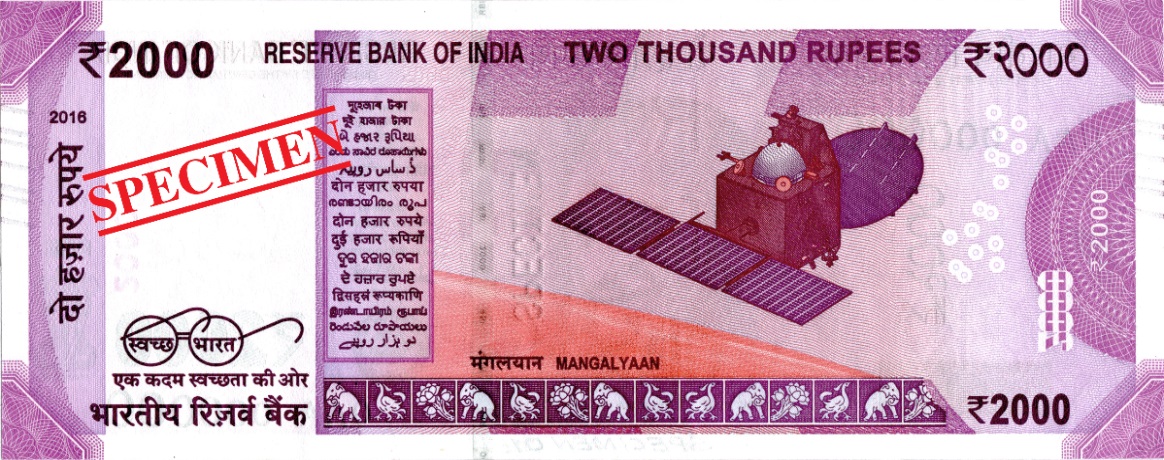
The Mahatma Gandhi (New) Series, introduced from 2016, combines the common principle of Gandhi’s portrait on the front with reverses devoted to heritage and scientific achievement. More compact dimensions and distinctive colours accompanied the redesign. [17]
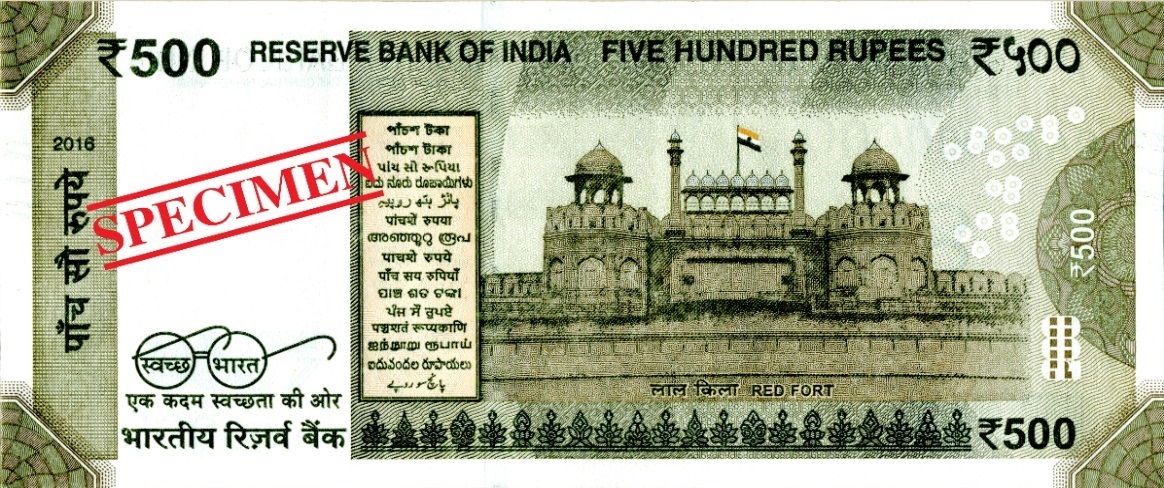

The 500-rupee note depicts Delhi’s Red Fort with the national flag, connecting Mughal architecture with the history of independence. A monument can acquire new meanings without changing its stones: a former centre of imperial power enters the story of modern sovereignty.
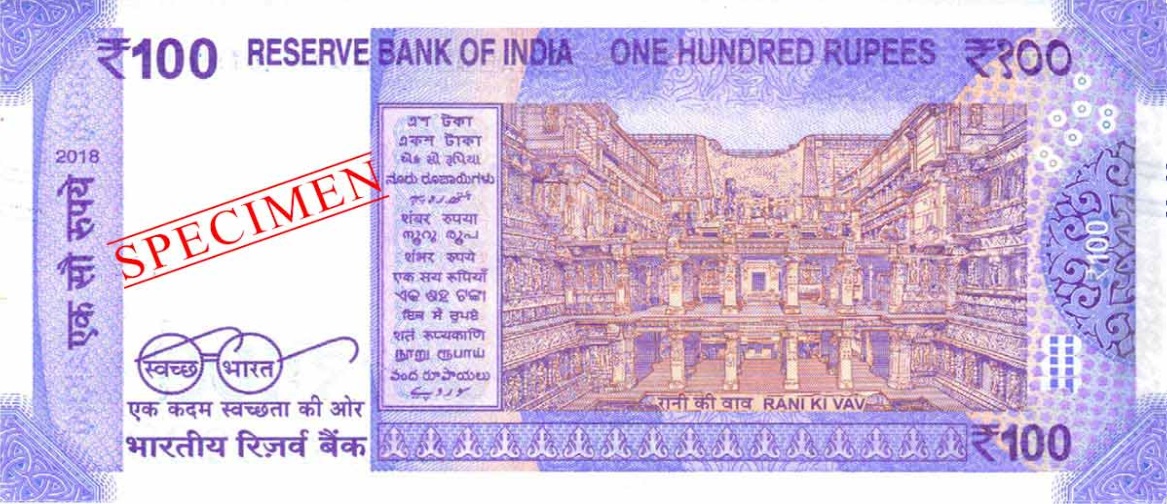

The 100-rupee note shows Rani ki Vav, the stepwell at Patan in Gujarat. Featuring this architecture of water takes the viewer beyond the most immediately familiar monuments. Other denominations form a wider itinerary: Konark’s Sun Temple on 10 rupees, the Ellora caves on 20, Hampi on 50 and Sanchi Stupa on 200. The 2,000-rupee note depicts Mangalyaan, India’s Mars mission. [17]
| ₹ | Design |
|---|---|
| 10 | Konark — Sun Temple |
| 20 | Ellora caves |
| 50 | Hampi — stone chariot |
| 100 | Rani ki Vav — stepwell |
| 200 | Sanchi Stupa |
| 500 | Delhi’s Red Fort |
| 2 000 | Mangalyaan — Mars mission; withdrawal announced in 2023 |
These images bring together different regions, traditions and periods without attempting an exhaustive inventory of India. Above all, they demonstrate how an everyday object can carry culture. Wear does not erase that ambition: a piece of heritage travels from hand to hand, far from the monument it represents.
From metal to screen: understanding UPI and the digital rupee
In the twenty-first century, the rupee’s history extends beyond its visible physical forms. Piloted in April 2016, before November’s demonetisation, the Unified Payments Interface was developed by NPCI. It enables bank-account transfers through interoperable applications. The QR code becomes a new meeting point between merchant and customer. [18]
UPI is payment infrastructure rather than a separate currency. Money transferred through it remains denominated in rupees. Its growth cannot be explained by a single event; access to banking, phones, networks and changing habits also matters. The speed of these payments changes the experience of settling a purchase without changing the name of the unit used.
The digital rupee raises a different issue: a digital form of central bank money. The first pilots began on 1 November 2022 for wholesale use and on 1 December for retail use. A claim on the central bank differs from a commercial-bank deposit transferred through UPI, even where user interfaces may converge. [19]
Predicting the disappearance of cash is unnecessary to understand this development. Coins, paper, deposits and newer forms tell the story of functions that coexist or are reorganised. From the ancient punch mark to the QR code, one thread remains: recognising value, expressing it and transmitting it within a shared framework.
Timeline
- c. sixth century BCE
- Development of punch-marked coinage; chronology debated
- 1540–1545
- Sher Shah’s silver rupiya
- 1835
- Uniform Company coinage in British India
- 1861
- Government monopoly of note issue
- 1917
- Introduction of the one-rupee note
- 1935 / 1938
- RBI opens / first RBI notes
- 1947 / 1949 / 1950
- Independence / redesigned one-rupee note / new coins
- 1957
- 100 naye paise to the rupee
- 1966
- Devaluation on 6 June
- 1991–1994
- Exchange adjustments, unified rates, current-account convertibility
- 1996 / 2010
- Mahatma Gandhi series / adoption of ₹
- 2016
- UPI, demonetisation of older series, redesigned notes
- 2022 / 2023
- First digital-rupee pilots / 2,000-rupee withdrawal announced
Sources and credits
References consulted on 15 October 2026. Institutional sources and object records distinguish issue dates, monetary decisions and numismatic types.
- RBI Monetary Museum — Ancient India coinage
- RBI Monetary Museum — Mughal coinage
- RBI — History of Indian currency (1998)
- RBI Monetary Museum — Republic India coinage
- RBI Monetary Museum — British India paper money
- RBI — Brief history; chronology 1935–1949
- RBI — Indian currency: frequently asked questions
- RBI Monetary Museum — Republic India paper money
- Lok Sabha — Estimates Committee, 1967 (p. 76), devaluation of 6 June 1966
- RBI — Historical data: external sector reforms and convertibility
- SPMCIL — Products: coinage and government mints
- SPMCIL — Currency Note Press Nashik; RBI — functions
- RBI — Currency circular: banknote designs and series
- Press Information Bureau — Indian rupee symbol, 2010
- RBI — Withdrawal of legal tender status, 8 November 2016
- RBI — Annual report 2022–23: chronology, 19 May 2023
- RBI — Currency management, new series and production
- NPCI — UPI product booklet and launch chronology
- Government of India, PIB — Digital rupee pilots
- CSMVS — Punch-marked coins, collection record
- NPCI — UPI frequently asked questions
- Wikimedia Commons — Currency: India and reuse conditions
Photographs are stored locally, with credits beneath each image. Recent specimens use RBI reproductions made available under GODL-India on Commons. Historical images and photographic licences are documented in the accompanying manifest. The illustrations are presented for documentary purposes.