A British anchor, French sous, a rupee shaped by connections with India and a dodo inside a transparent window: Mauritian money tells the story of an island connected to the world. Objects matter as much as dates in following that story.
Before the rupee: money arriving by sea
A coin does not have to bear the name Mauritius to belong to the island’s history. For centuries, money arrived aboard ships: coins struck overseas passed from hand to hand, while accounts could be kept in units different from the pieces available. Distinguishing a unit of account from the coins used for payment is the first step towards understanding this monetary world.
There is no documented pre-settlement island currency system to reconstruct. Dutch settlement began in 1638 and ended in 1710. French possession in 1715 preceded a lasting settlement in the 1720s. As the Isle de France developed into a port and trading centre, European and Asian commercial networks met there. The words livre, piastre and rupee belonged to different monetary traditions that would overlap on the island.
Money also circulated within a profoundly unequal colonial society shaped by slavery. Its history therefore involves more than port regulations and official exchange tables. It asks who was paid a wage, who could own an account and who was free to control the proceeds of their work. The experience of money differed sharply according to a person’s place within that society.
1810: a piastre made in response to scarcity
A shortage of coins near the end of French rule prompted Governor Charles Decaen to arrange a local issue. The 1810 Decaen piastre was denominated at ten livres. Its obverse combined the imperial eagle with the inscription “Isles de France et Bonaparte”; the reverse placed the denomination within a wreath. Isle Bonaparte was the contemporary name of Réunion.
The Bank of Mauritius Museum attributes the design to the engraver and jeweller Aveline and connects its silver to the Portuguese ship Ovidor, captured in 1809. Maritime warfare, the supply of metal and the making of money came together in this episode. Local manufacture answered a particular shortage; it did not establish a continuous industrial minting tradition on the island.
British conquest in December 1810 did not instantly remove earlier means of payment. A coin can outlive the authority that issued it when people continue to recognise it in transactions. The Decaen piastre is therefore evidence of a transition between administrations, as well as an object from the French imperial period.
1822: two monetary languages on one island
The British authorities sought to supply smaller coins. The issues known as Anchor Money were based on the Spanish dollar. Coins dated 1820 were sent to Mauritius; the 1822 issues also served the British West Indies. Struck at London’s Royal Mint, their crowned anchor and fractional values were intended to make payments more manageable.
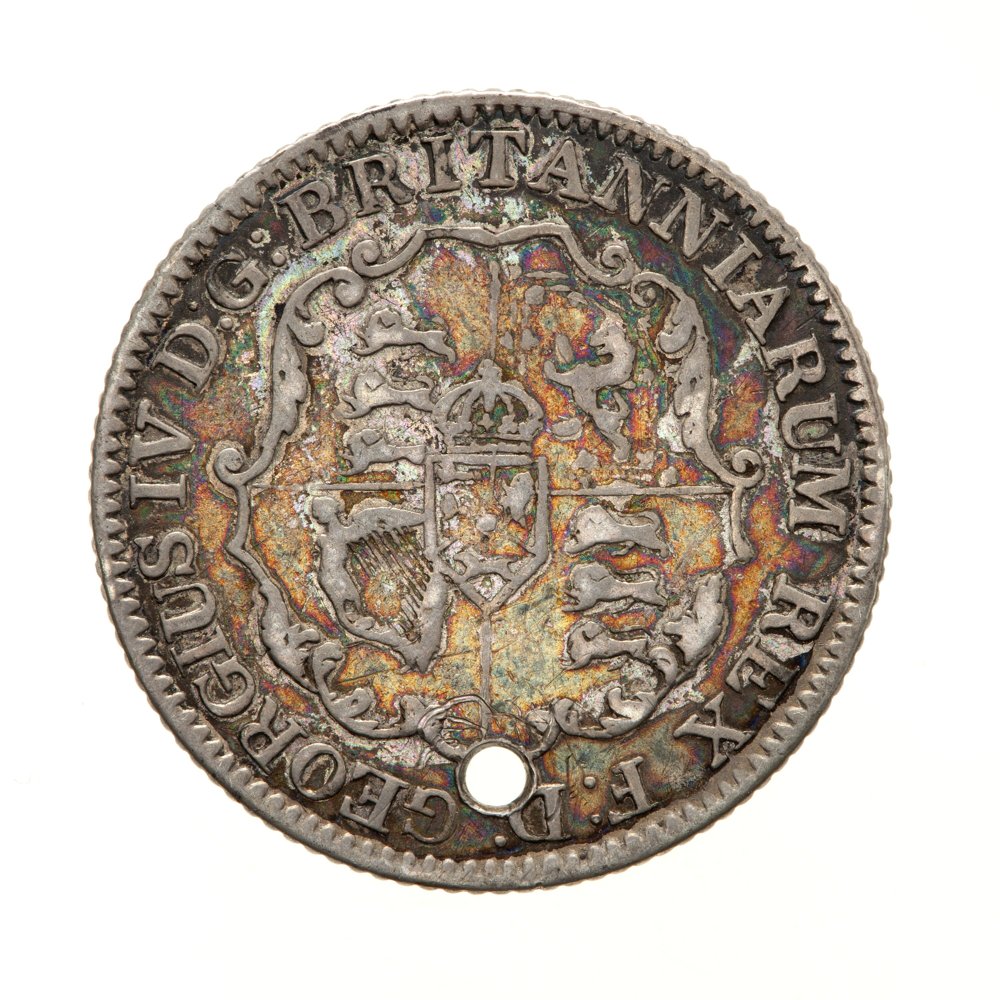
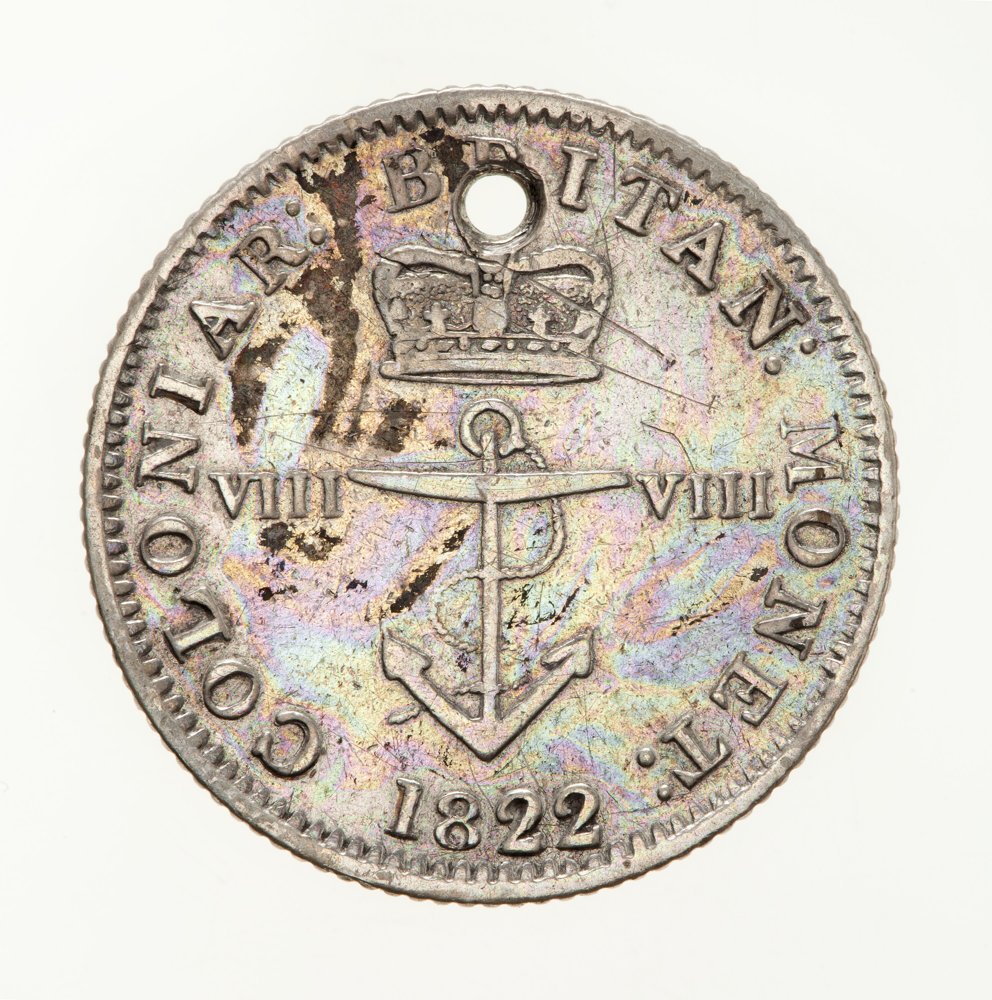
Another coin of the same year reveals the persistence of French habits. The 1822 fifty-sous piece was struck in Calcutta for a British administration but carried French inscriptions. Palm trees and an abbreviated reference to the government of Mauritius and its dependencies appeared on one face, with the value and Treasury wording on the other. A change of sovereignty had not erased the language of transactions.
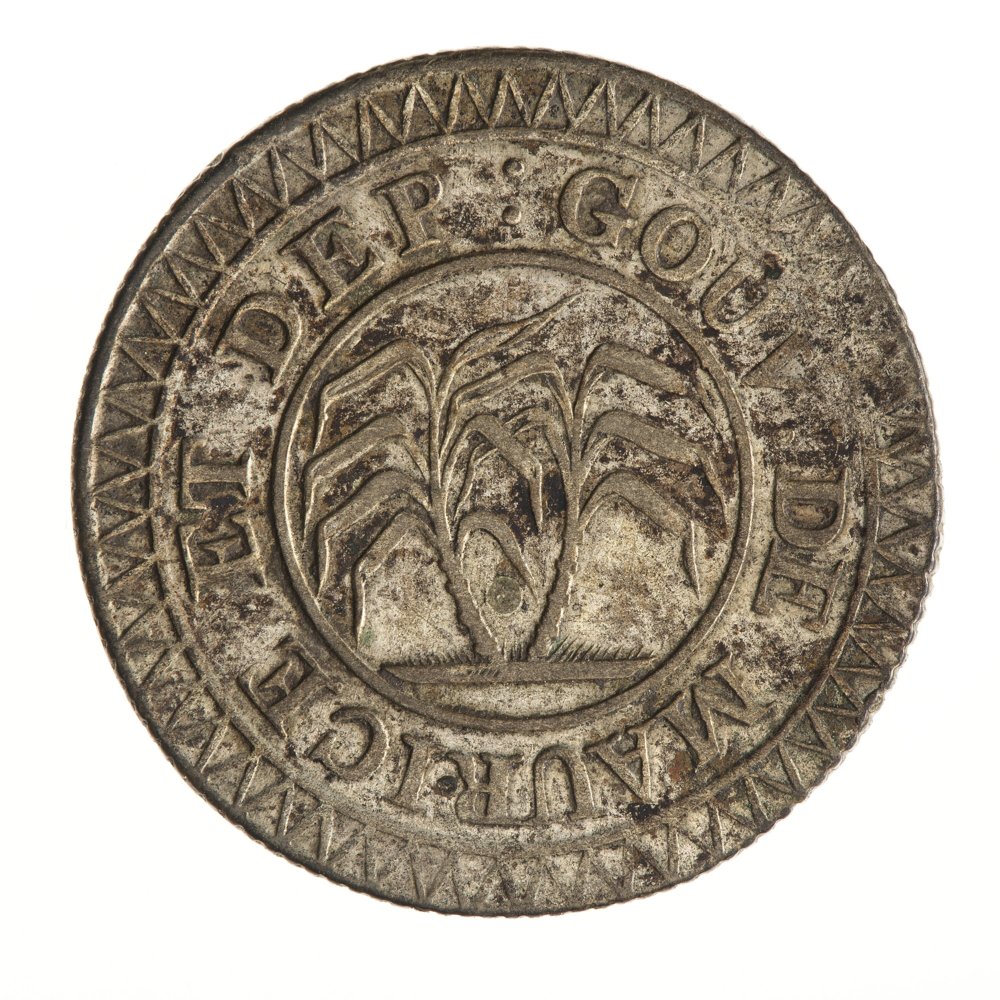
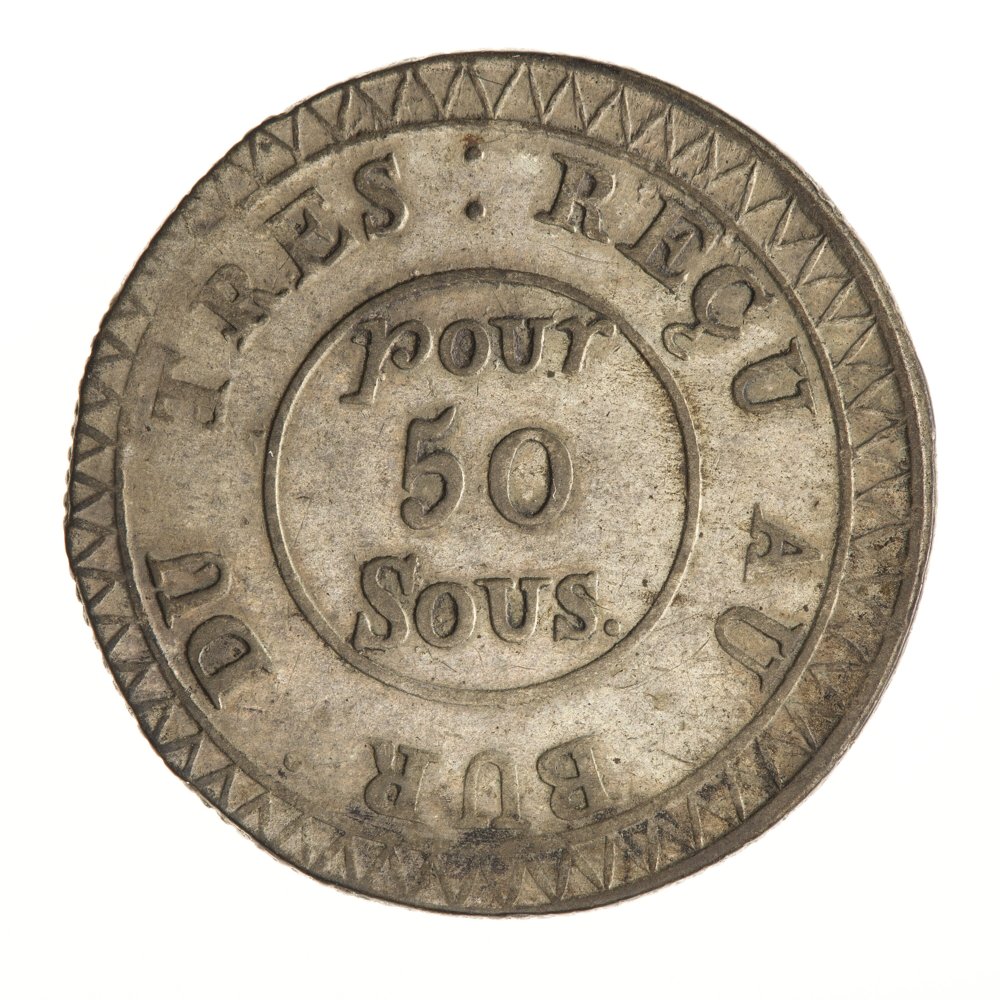
These objects should not be forced into a simple sequence of replacements. A newly issued coin did not immediately displace every older one. Foreign pieces, accounting customs and administrative decisions could coexist. The two issues of 1822 make that layered monetary world tangible: one looks towards an imperial currency shared across oceans, the other preserves a local vocabulary.
Museums Victoria · 1/8 dollar 1822, NU 12010 · Museums Victoria · 50 sous 1822, NU 14139
Sugar, workers and access to money
Sugar plantations shaped nineteenth-century Mauritius. The abolition of slavery in 1835 did not mark the beginning of all indentured immigration: the British experiment in recruiting Indian indentured workers had begun in 1834. Aapravasi Ghat in Port Louis preserves the memory of this immense movement of people.
Wages, shop purchases and debts brought money into everyday life. Yet different means of payment offered different degrees of freedom. The monetary museum preserves a token from the Schoenfeld estate, an example of “domain currency” usable within a particular property. Receiving value that could not be spent elsewhere restricted a worker’s choices in a very practical way.
A common monetary unit must therefore be distinguished from the conditions under which people gained access to money. The rupee alone could not remove the constraints of colonial labour. Nor could its adoption in 1877 have caused an immigration movement that began decades earlier. Human and commercial connections with India preceded the reform and help explain its setting. The history of the rupee is inseparable from those connections, but the chronology matters.
UNESCO · Aapravasi Ghat · Aapravasi Ghat Trust Fund · Magazine 2019, histoire monétaire · Bank of Mauritius Museum · Gallery
1877: the rupee becomes the common standard
The legal turning point came in 1876, with implementation on 1 January 1877. The Order in Council of 12 August 1876 prescribed the Indian rupee standard. Mauritius adopted a rupee divided into 100 cents, while India still used annas and a non-decimal subdivision. Choosing the same basic unit did not mean copying every part of the Indian system.
The earlier Mauritius dollar was replaced at two rupees to one dollar. This was the historical dollar associated with the piastre world, not a conversion against today’s US dollar. Equally, 1877 was not the first appearance of the word rupee on the island’s money: notes had already been denominated in rupees in the middle of the century.
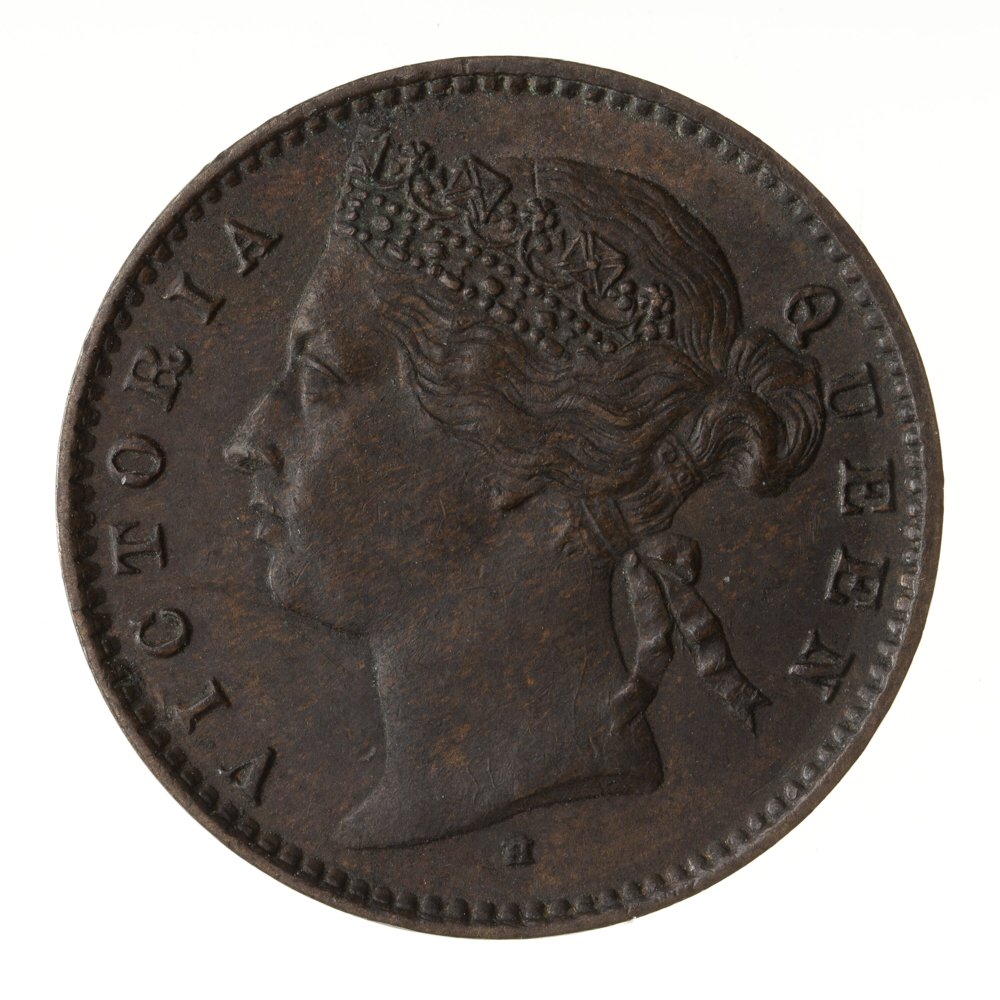
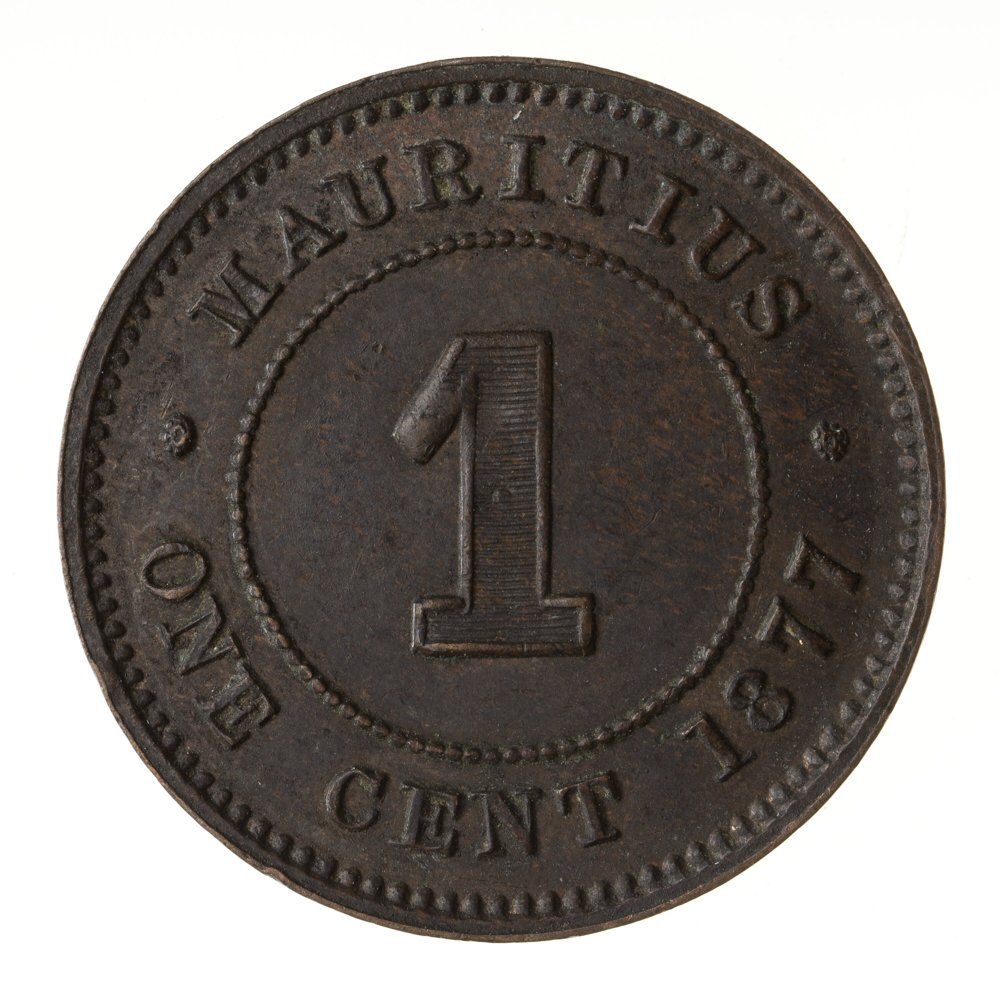
The subsidiary coinage comprised 1, 2, 5, 10 and 20 cents. Small bronze coins and the silver denominations served different payment needs. A country’s name on a coin does not necessarily identify its place of manufacture: the cent shown here was made in Birmingham. Separating the issuing authority from the mint and the engraver is essential when reading a numismatic catalogue.
Aapravasi Ghat Trust Fund · Magazine 2019, histoire monétaire · Krus & Schuler · Currency Board Financial Statements, notice Mauritius · Museums Victoria · 1 cent 1877 H, NU 48205
Paper money: promises, signatures and portraits
Several institutions issued money before the central bank. Commercial banks produced their own notes; the Board of Commissioners of Currency, established in 1849, became a central part of colonial currency arrangements. A banknote was more than printed paper. It represented an obligation backed by an issuer whose name and signatures were intended to command confidence.
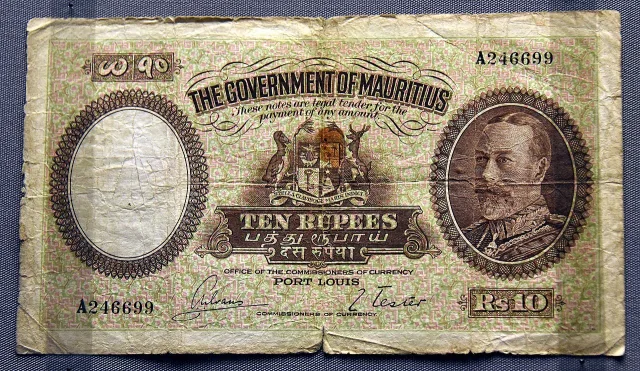

The 1930 note can be read at three levels. George V’s portrait asserts British sovereignty; the arms and Port Louis wording locate the object; the value in different scripts acknowledges a varied readership. A clear area accommodates the watermark, while ornamental linework, serial numbering and signatures surround the monetary promise. Its folds are reminders that a museum object was once something handled in ordinary transactions.
Note production required skills different from those of a coin mint. The museum emphasises Mauritius’s longstanding connection with the security printer Thomas De La Rue. Printed paper could carry substantial value without containing precious metal. Its acceptance depended on the issuing institution and its recognised role in payments.
In 1934 the rupee’s sterling relationship was fixed at 13⅓ rupees to one pound. A new external anchor did not turn the local note into a pound: domestic amounts remained in rupees. An unchanged currency name could therefore conceal a major alteration in the monetary framework.
Bank of Mauritius Museum · Gallery · Krus & Schuler · Currency Board Financial Statements, notice Mauritius
1967–1968: a central bank before independence
The Bank of Mauritius was established in 1967 under the 1966 legislation. Its first Governor, Aunauth Beejadhur, took office on 1 July 1967. The first annual report distinguishes preparatory work, the start of operations in August and formal establishment in September. This was a staged institutional transition, rather than an event that can be reduced to a single date.
A currency board is primarily concerned with issuing currency and its backing. A central bank has a wider range of responsibilities and instruments affecting money, credit and the banking system. When Mauritius became independent on 12 March 1968, the new monetary authority was already in place. Independence neither created a replacement rupee nor removed zeros from prices.
The 1967 notes still portrayed Elizabeth II, while their backs depicted the island’s buildings, harbour, sugar cane and landscapes. Political change and changes in monetary imagery did not necessarily follow the same timetable. Mauritius became a republic on 12 March 1992: a separate milestone that should not be confused with either independence or the origin of its currency.
Bank of Mauritius · Annual Report 1968 · Bank of Mauritius · Virtual Museum · Gouvernement mauricien · Histoire de l’île
One rupee, changing monetary arrangements
Keeping the unit of account at independence did not freeze every monetary rule. On 5 January 1976, the direct link to sterling was replaced by a link to the IMF’s Special Drawing Right, then based on a basket of currencies. The Bank explained the decision in terms of the effect of sterling depreciation on import costs.
The mechanism can be understood without memorising a rate. When an anchor currency falls against others, goods priced in those other currencies can become more expensive in rupees. Choosing a different reference seeks to reflect a broader set of external relationships. It does not change the number stamped on a coin already in someone’s pocket.
Exchange controls were abolished in July 1994. The expansion of manufacturing, tourism and services widened the uses of the rupee, but did not automatically guarantee a stable external value. Institutional history is more informative here than a story of a “miracle currency”. It makes the choices accompanying the island’s transformation visible, without assuming that each new industry must mechanically strengthen its money.
Bank of Mauritius · Quarterly Review, January–March 1976 · Bank of Mauritius · Role and Functions
1998–1999: a new series and a shared public identity
The family launched on 30 October 1998 was soon scheduled for replacement. A February 1999 notice temporarily retained the older notes in circulation. The communiqué of 29 June announced a new family from 1 July 1999, with earlier notes losing legal-tender status on 1 October 1999. The 1,000-rupee note was to follow the first six denominations.
Collectors need this chronology: notes with similar colours and portraits can belong to legally distinct issues. The 1998 controversy over the ordering of Tamil and Devanagari scripts also shows that the placement of a denomination is not a neutral detail. This account follows the issuer’s documented dates without repeating conflicting versions of the precise language order.
Mauritian figures occupy a prominent place in the designs. Sir Jean Moi Lin Ah-Chuen appears on 25 rupees, Maurice Paturau on 50, Renganaden Seeneevassen on 100 and Sir Abdool Razack Mohamed on 200. Higher denominations portray Sookdeo Bissoondoyal, Sir Charles Gaëtan Duval and Sir Seewoosagur Ramgoolam. Together they offer a national memory expressed through several voices.
Reverse designs turn towards places and activities: Rodrigues, the market, the university, sega dancing and the transport of sugar cane. A note combines recognition of individuals with scenes of shared life. Like a small exhibition, it selects part of the national story. That selection can be read and questioned rather than treated as a complete inventory of the country’s history.
Bank of Mauritius · Banknotes in Circulation, 26 February 1999 · Bank of Mauritius · New Family of Banknotes, 29 June 1999 · Clifford Vellien / Reuters, 19 November 1998 · historical Usenet reproduction · Bank of Mauritius · Virtual Museum
2013–2025: the dodo enters the transparent window
On 22 August 2013, polymer notes appeared in the 25-, 50- and 500-rupee denominations. The substrate changed more than the visual narrative. It made a transparent window possible, with a dodo motif. A bird familiar from the watermark of earlier paper notes now became visible in the window: a heritage emblem also served as a security feature.
Polymer was chosen for durability and the protective features it could accommodate. A window is part of the substrate itself, not merely an illustration printed on an opaque surface. For a historian of technology, this is as meaningful as a change of portrait. It alters both the making of a note and the way it can be examined.
| Introduction date | Denominations | Historical milestone |
|---|---|---|
| 22 August 2013 | 25, 50 and 500 rupees | First polymer issues |
| 5 December 2018 | 2,000 rupees | Replacement of the high-value paper note |
| 2 December 2024 | 1,000 rupees | New polymer issue |
| 20 June 2025 | 100 rupees | Window and dodo; paper notes retained alongside |
| 18 July 2025 | 200 rupees | Another stage in the transition |
The sequence corrects a common misunderstanding: the introduction of polymer in 2013 did not mean that every denomination changed material that year. Changes were staggered, with different withdrawal arrangements for different issues. This table records historical introductions; the Bank’s notices remain the source for the status of a particular note.
Bank of Mauritius · Polymer Banknotes, FAQ 2013 · Bank of Mauritius · Annual Report 2013–14 · Bank of Mauritius · Rs2000 paper notes, withdrawal notice · Bank of Mauritius · Annual Report 2018–19, pp. 32, 120 (copie ARMC) · Bank of Mauritius · Rs1000 polymer, 2 December 2024 · Bank of Mauritius · Rs100 polymer, 20 June 2025 · Bank of Mauritius · Rs200 polymer, 18 July 2025
Coins: everyday payments and national memory
The history of the rupee extends beyond banknotes. Coin design works within a tiny area: value, portrait, relief and edge must remain recognisable after thousands of transactions. The obverse is the principal face, often bearing a portrait; the reverse commonly carries the denomination or another motif. This convention should be applied with care, since catalogues do not always present the faces in the same way.
The series portraying Sir Seewoosagur Ramgoolam gave small change a national effigy. Comparing generations means looking at portrait, date and denomination together. A new face does not necessarily mean a new currency unit. The 10-rupee coin launched in September 1997 and the 20-rupee issue associated with the Bank’s fortieth anniversary in 2007 continued the development of circulating denominations.
Collector issues explore other materials alongside ordinary small change. Dodo gold coins struck by the Royal Mint celebrate an extinct bird that became a Mauritian emblem. Platinum issues from 2009 to 2011 honoured Ramgoolam and places of memory, including Aapravasi Ghat and Le Morne. Their face values should be distinguished from prices reflecting precious metal and collecting interest.
Such production recalls the international networks already visible in nineteenth-century coinage. The Mauritian issuing authority chooses an issue; specialist manufacturers give it physical form. From Calcutta and Birmingham to contemporary production, the geography of manufacture belongs to the island’s monetary history. National money is also an object created through connections beyond its shores.
Bank of Mauritius · Annual Report 1997–98 · Bank of Mauritius · Annual Report 2007–08 · Bank of Mauritius · Commemorative and Dodo coins · Bank of Mauritius · Annual Report 2013–14
Key dates
- 1810The Decaen piastre is made on the island.
- 1822Imperial anchor money and French sous coexist.
- 1849The Board of Commissioners of Currency is established.
- 1876–1877Legislation followed by implementation of the rupee standard.
- 1967–1968Central bank, then independence.
- 1998–1999Two note families follow each other in quick succession.
- 2013–2025Polymer banknotes are introduced in stages.
Sources and credits
Photographs in this feature show historical issues. Modern notes and coins are described using the issuer’s sources; their images are omitted where reuse rights for the currency design have not been established. Captions identify the photographer, source and image licence. Adaptations of CC BY-SA 4.0 images retain that licence.
Research and documentary checks: 15 October 2026. Polymer dates refer to announced introductions, rather than dates printed on every example. The links below support further research; the article and all its photographs remain available offline.
- Gouvernement mauricien · Histoire de l’île
- Bank of Mauritius Museum · Gallery
- Museums Victoria · 1/8 dollar 1822, NU 12010
- Museums Victoria · 50 sous 1822, NU 14139
- Museums Victoria · 1 cent 1877 H, NU 48205
- UNESCO · Aapravasi Ghat
- Aapravasi Ghat Trust Fund · Magazine 2019, histoire monétaire
- Krus & Schuler · Currency Board Financial Statements, notice Mauritius
- Bank of Mauritius · Annual Report 1968
- Bank of Mauritius · Role and Functions
- Bank of Mauritius · Quarterly Review, January–March 1976
- Bank of Mauritius · Virtual Museum
- Bank of Mauritius · New Family of Banknotes, 29 June 1999
- Bank of Mauritius · Banknotes in Circulation, 26 February 1999
- Bank of Mauritius · Polymer Banknotes, FAQ 2013
- Bank of Mauritius · Annual Report 2013–14
- Bank of Mauritius · Rs2000 paper notes, withdrawal notice
- Bank of Mauritius · Annual Report 2018–19, pp. 32, 120 (copie ARMC)
- Bank of Mauritius · Rs1000 polymer, 2 December 2024
- Bank of Mauritius · Rs100 polymer, 20 June 2025
- Bank of Mauritius · Rs200 polymer, 18 July 2025
- Bank of Mauritius · Annual Report 1997–98
- Bank of Mauritius · Annual Report 2007–08
- Bank of Mauritius · Commemorative and Dodo coins
- Clifford Vellien / Reuters, 19 November 1998 · historical Usenet reproduction
- Bank of Mauritius · Reproduction guideline, April 2017