Before the rupiah: an archipelago of currencies
The Indonesian rupiah carries a history much older than the Republic. For centuries, the islands of Nusantara belonged to trading networks that connected merchants, kingdoms, ports and different monetary traditions. There was no single national currency and no monetary frontier matching the borders of present-day Indonesia. Surviving objects reveal overlapping worlds of exchange.
In Java, small gold and silver pieces known as ma or krisnala record the practices of medieval kingdoms. Copper gobog, associated particularly with Majapahit, also had ritual uses. A specimen in a collection should therefore not automatically be treated as everyday shopping money. The boundaries between currency, amulet and prestige object were sometimes less rigid than modern catalogues suggest.
Islamic kingdoms, including Aceh, Samudra Pasai, Banten and Palembang, issued coins often bearing Arabic inscriptions. In Sumenep, foreign coins received a local countermark: an authority could recognise metal already minted elsewhere. Chinese cash and silver from other trading networks contributed to this diverse monetary landscape.
Bank Indonesia · Currencies of the kingdoms of Nusantara · Bank Indonesia · BICARA 77, 2019
VOC copper and the routes of silver
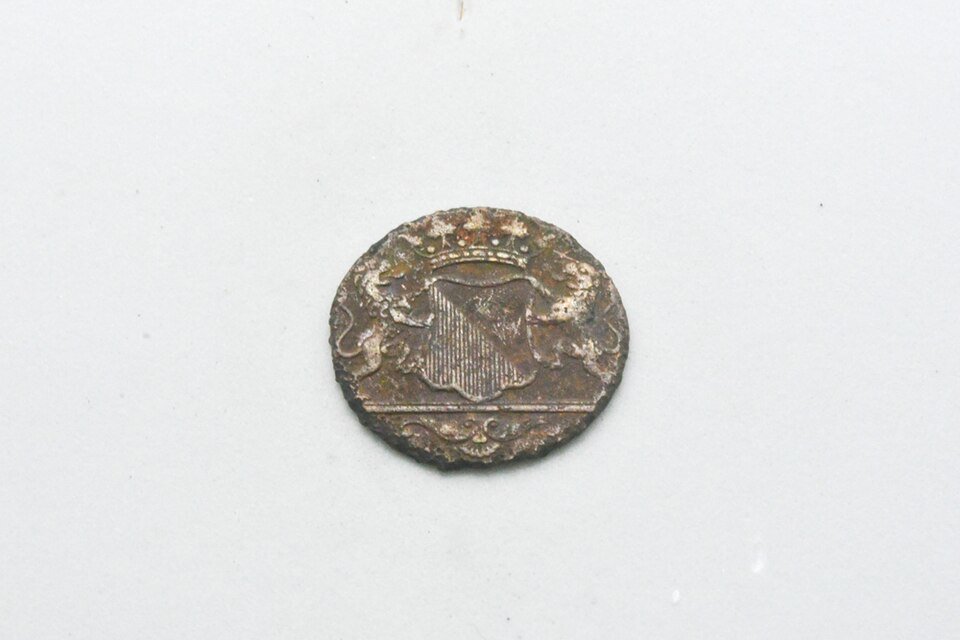
Founded in 1602, the Dutch East India Company, or VOC, entered these networks and progressively imposed commercial and territorial power. Its coins recall a world in which a company exercised powers now associated with states. The small copper duit, bearing the company monogram or provincial arms according to the side, belongs to this colonial setting.
The material matters as much as the date. Copper served small transactions; silver supported other payments and longer-distance trade. A port could accommodate several kinds of money, accepted according to local practice, weight, metal and confidence. The arrival of European coinage did not abruptly erase older customs.
The duit shown here comes from a museum collection photographed by a Wikimedia contributor. Its worn surface reveals a physical object rather than an ideal catalogue drawing. At this scale, monetary history is also the history of coins carried, counted and preserved far from the mint that made them.

1828: the guilder enters the banking age
The establishment of De Javasche Bank in Batavia on 24 January 1828 opened a new chapter. Operations began on 8 April. An issuing privilege brought banknotes into the commercial networks of the Dutch East Indies. The gulden, or guilder, was the colonial unit; it should not retrospectively be renamed the currency of the Indonesian Republic.
The bank’s earliest directors were closely connected with major trading houses. Their backgrounds illuminate its priorities: financing commerce and serving the colonial economy. Paper money was more than a convenient substitute for heavy coins. It depended on a bank, its reputation, its rules and the authority that sanctioned circulation.
A branch network subsequently expanded through Java and beyond. For anyone examining old notes, the issuer’s name offers an especially useful guide. De Javasche Bank, the Netherlands Indies government and, later, Bank Indonesia represented different authorities, even when buildings and technical knowledge passed from one institution to another.
Bank Indonesia · Banking history in Kediri · Bank Indonesia · The first directors of De Javasche Bank
1942–1945: changing names on paper
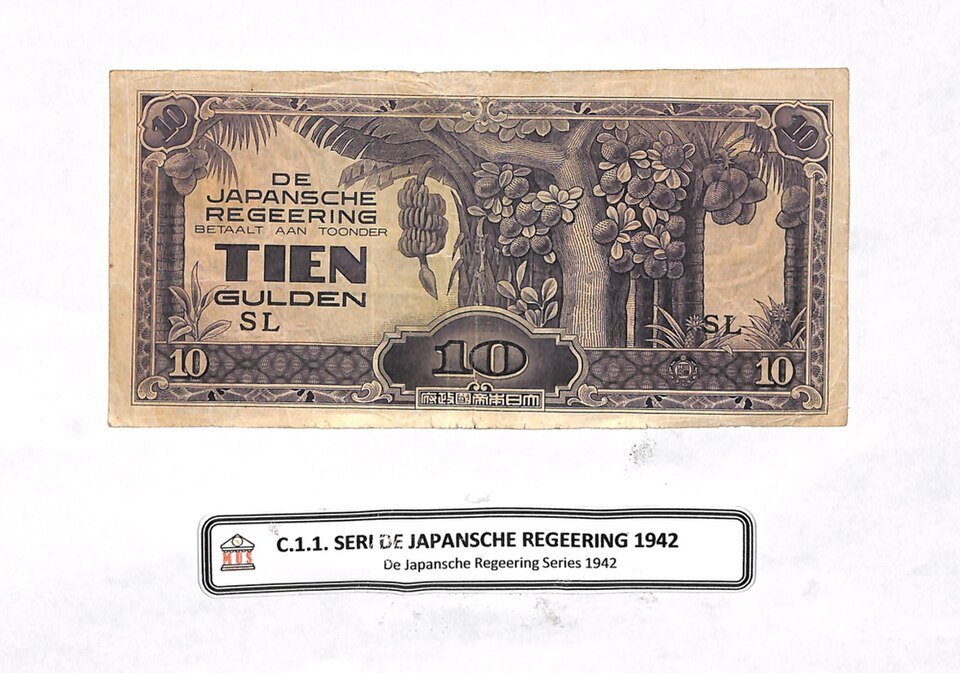
Japanese occupation from 1942 overturned the colonial system. The occupying authorities introduced their own paper money. Early issues retained Dutch wording and guilder denominations; later ones used Indonesian terminology, including roepiah. Changes in language made the succession of political powers visible.
The 10-gulden note below reads “De Japansche Regeering”, identifying the Japanese government. Its vegetation and ornamental design should not obscure its function: enabling a new authority to make payments. It was not the Republic’s ORI, although occupation money would shape monetary conditions after the war.
When independence was proclaimed on 17 August 1945, the claim to statehood did not immediately provide Republican cash throughout the territory. Several inherited currencies continued circulating. This transition explains why the rupiah’s history cannot be reduced to a single date printed on a note.

Bank Indonesia · Museum Collection · Bank Indonesia · Duel Uang Merah Vs Uang Putih
1946: the Republic acquires a monetary face
On the evening of 29 October 1946, Mohammad Hatta spoke on radio in Yogyakarta to announce that Oeang Repoeblik Indonesia, or ORI, would take effect the following day. Thus 30 October became a founding date in Indonesian monetary sovereignty. Oeang is the older spelling of uang, meaning money.
Yet the 1-rupiah note in the Smithsonian’s National Numismatic Collection is dated 17 October 1945. Printed dates and circulation dates must be distinguished: producing currency during a revolution required time, paper, presses and distribution networks. Soekarno’s portrait, wearing the peci, presented the Republic to its users, while the volcano on the reverse placed the note in a recognisable landscape.
ORI was issued by the Republican government; Bank Negara Indonesia helped put it into circulation. Military conditions and geography prevented uniform distribution. From 1947, regional issues known as ORIDA appeared, including in Sumatra and Banten. Their varied signatures and places of origin make them records of the Republic’s local organisation.
Accepting a currency could carry political meaning. Republican money and the money of the returning Dutch administration represented competing claims to sovereignty. Their areas of use were shifting: monetary unity emerged through warfare, negotiation and everyday transactions.
View the object in the source linked below.

Indonesian Ministry of Finance · Sejarah Oeang · Bank Indonesia · Duel Uang Merah Vs Uang Putih · Benteng Vredeburg Museum · History of ORI, 1946–1949
1950–1953: from scissors to a central bank
After the December 1949 transfer of sovereignty, bringing different monetary areas together was an urgent task. In March 1950, Finance Minister Sjafruddin Prawiranegara introduced a famous measure: specified De Javasche Bank and Netherlands Indies notes above 2.50 guilders were to be cut in half.
The left half remained spendable at half the original face value; the right half was to be exchanged for government bonds. “Sjafruddin’s scissors” therefore converted part of immediately available money into a claim on the state. This striking intervention should not be confused with a simple change in the external exchange rate.
The nationalisation of De Javasche Bank in 1951 prepared another transformation. On 1 July 1953, Bank Indonesia became the Republic’s central bank, with Sjafruddin as its first governor. Political independence in 1945, ORI’s first circulation in 1946 and Bank Indonesia’s institutional foundation in 1953 were separate milestones.
Collectors can follow this transition through issuers’ names and signatures. For the country, it meant that currency administration could rely on a national institution that inherited a banking network while acquiring a different political purpose.
Bank Indonesia · Archives and history of Cirebon · Bank Indonesia · Sjafruddin Prawiranegara · Bank Indonesia · Institutional history
1959–1971: changing values, uniting monetary territories
Financing difficulties and severe inflation brought further interventions. In August 1959, 500- and 1,000-rupiah notes were reduced respectively to 50 and 100 rupiah. This targeted reduction did not automatically convert every sum in the country into a uniformly rescaled unit.
The reform of 13 December 1965 was different: 1 new rupiah replaced 1,000 old rupiah. Three zeros disappeared. Rescaling accounts, however, was insufficient to restore confidence or resolve shortages and imbalances. Stabilisation required decisions extending beyond the printing presses.
Territorial monetary unification also proceeded in stages. The Riau Islands received a separate rupiah in 1963 before joining the common currency on 1 July 1964. In West Irian, the special currency introduced in 1963 lasted longer; replacement by the national currency began in 1971. These monetary transitions alone do not tell the political history of those territories.
On the illustrated 5-rupiah note, “Irian Barat” identifies a regional issue. The printed date, 1960, precedes its regional introduction. It is another reminder to compare printed dates, issuing measures and actual circulation.
View the object in the source linked below.

Bank Indonesia · Monetary policy instruments · Bank Indonesia · Museum Collection
Making trust: engravers, presses and metals
Monetary sovereignty also rests on an industry. Designing a recognisable portrait, engraving fine lines, preparing inks, printing serial numbers and checking sheets involve different trades. Coin production has its own demands: preparing blanks, making dies and achieving relief that can withstand wear.
Bank Indonesia’s earliest notes did not all come from one establishment. The bank’s collections identify work with Thomas De La Rue, Johan Enschedé and Pertjetakan Kebajoran. The national history of banknotes therefore includes relationships with foreign printers and the development of domestic capacity.
PERURI was established on 15 September 1971 by merging PN Arta Yasa and PN Pertjetakan Kebajoran. Bringing minting and printing expertise together provided an industrial base for Indonesian cash production. Manufacture must be distinguished from issuance: a production establishment makes the currency ordered, while the monetary authority organises its issue.
The 1999 regulation for the 100,000-rupiah note also records the use of a plastic substrate. Contrasting that with the cotton fibres specified for the 2022 1,000-rupiah note shows that banknote materials do not develop along a single inevitable path. Substrate and security choices respond to the technical needs of particular issues.
PERURI · Company profile · PERURI · Official company history · Bank Indonesia Regulation 1/8/PBI/1999 · 100,000-rupiah note
1997–1998: crisis reaches everyday wallets
On 14 August 1997, amid the Asian financial crisis, Bank Indonesia abolished its exchange-rate intervention band and allowed the rupiah to float. The IMF’s same-day announcement dates this break precisely. Its initially positive response contrasts with the severity of the crisis that followed: contemporary documents must be read in their own moment, without attributing hindsight to their authors.
Depreciation increased the rupiah burden of foreign-currency debts. Corporate difficulties, banking weakness and lost monetary confidence reinforced one another. Households faced higher prices and greater uncertainty over savings and earnings. The government’s January 1998 memorandum records the difficulty of restoring conditions despite the initial measures.
Recovery involved bank restructuring and institutional change. The 1999 law granted Bank Indonesia independence. The formal inflation-targeting framework was adopted on 1 July 2005: these are different dates and should not be conflated.
This history helps explain the scale of familiar banknote denominations without reducing Indonesia to its crises. A large face value is a matter of accounting and monetary history; by itself, it says little about a society’s wealth or the abilities of its people.
IMF · Announcement of 14 August 1997 · Indonesian Government / IMF · Memorandum of 15 January 1998 · IMF · Recovery from the Asian Crisis · Bank Indonesia · Monetary policy framework
Small metal tells the country’s story too
Coins give the narrative another scale. Circulation leaves visible marks on relief, fields and edges. Material, colour and diameter help distinguish values by touch and at a glance; they are part of how money works, alongside its design.
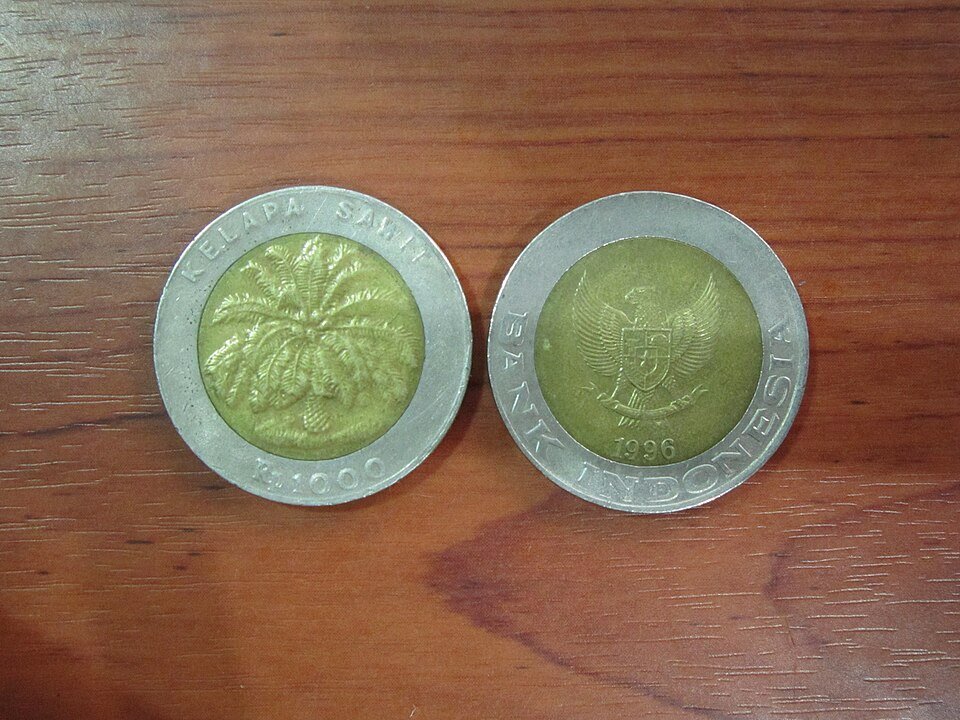
The bimetallic 1,000-rupiah type introduced in 1993 is especially distinctive. Its differently coloured centre and ring surround an oil palm on one side; the Garuda appears on the other. The photograph includes an example dated 1996: the introduction of a type and the date of an individual coin are different facts.
This type was withdrawn from circulation effective 1 December 2023 under Bank Indonesia Regulation 14/2023. Its illustration belongs here as a historical object, without suggesting that it remains spendable. A photograph can stay unchanged while the monetary status of the object changes.
The agricultural motif can be read as a choice about representing the country’s productive life. The Garuda, the state emblem, establishes continuity of authority across otherwise very different issues. Together, the two faces connect production, public authority and everyday recognition in a small object.

2020: 75,000 rupiah for a shared anniversary
On 17 August 2020, the government and Bank Indonesia launched a 75,000-rupiah note for the 75th anniversary of independence. The unusual number follows a commemorative logic; it was not a new ordinary step between 50,000 and 100,000 rupiah.
The issue received legal-tender status. This is a useful distinction: a commemorative banknote can be real money even when its historical interest encourages people to keep it. At its launch, the authorities explained that the purpose was to celebrate the anniversary rather than provide monetary financing for economic activity.
The reverse brings together children in traditional dress, cartographic elements and motifs of connection. The image presents diversity as a community: different cultural identities can share a payment instrument. With different figures and colours, this continues the national representational role already visible in ORI.
A collection benefits from bringing humble everyday cash together with exceptional issues. The former records repeated gestures; the latter illuminates the dates a society chooses to celebrate publicly.
View the object in the source linked below.

2022: a portrait of Indonesia in seven denominations
The 2022 series comprises seven denominations, from 1,000 to 100,000 rupiah. Its official issue date is 17 August 2022; the launch ceremony took place on 18 August. The series retains the national figures used in 2016, with revised colours, durability and security features. Introducing it did not by itself invalidate earlier series.
The 1,000-rupiah note makes this visual programme tangible. On the front, Tjut Meutia represents Aceh’s memory and resistance to colonial rule. On the reverse, the Tifa dance meets the landscape of Banda Neira and the Larat orchid. The two sides do more than pair a portrait with decoration: they connect places and forms of heritage.
Soekarno’s peci on ORI and the contemporary dancer’s clothing belong to very different moments in this visual language. The early note asserts the Republic’s existence; the later one circulates cultural references within a unified monetary space. Reading the images this way does not replace historical context; it helps reveal the designers’ choices.
The series’ theme is unity in diversity. Its effectiveness also rests on practical choices: distinguishing denominations, making security features identifiable and ensuring durability. For the 2022 1,000-rupiah note, Bank Indonesia specifies cotton fibres and dimensions of 121 × 65 mm.
| Value in rupiah | Figure on the obverse | Dance and landscape on the reverse |
|---|---|---|
| 1,000 | Tjut Meutia | Tifa · Banda Neira |
| 2,000 | Mohammad Hoesni Thamrin | Piring · Ngarai Sianok |
| 5,000 | Idham Chalid | Gambyong · Bromo |
| 10,000 | Frans Kaisiepo | Pakarena · Wakatobi |
| 20,000 | G.S.S.J. Ratulangi | Gong · Derawan |
| 50,000 | Djuanda Kartawidjaja | Legong · Komodo |
| 100,000 | Soekarno & Mohammad Hatta | Topeng Betawi · Raja Ampat |
View the object in the source linked below.

View the object in the source linked below.

Bank Indonesia · Launch of the 2022 series · Bank Indonesia · Official entry for the 2022 1,000-rupiah note · International Association of Currency Affairs · Indonesia 2022 series
Reading a banknote as an archive
A sound numismatic reading starts with simple questions: who issued the object, what value does it state, which date appears on it and where was it intended to circulate? Portraits, signatures and territorial wording add further clues. “Irian Barat” and “SPESIMEN” have specific functions: one identifies a regional issue; the other marks an official presentation specimen in the cited source illustrations.
The examples in this dossier are not a complete catalogue. They were selected to make transitions visible: a new authority in 1942, Republican assertion in 1946, regional issuance, industrial production, commemoration and cultural heritage. Moving from copper to paper and then to secured banknotes was not a wholesale replacement: coins and notes coexist and serve different uses.
From the islands’ kingdoms to a national rupiah, the story is one of gradual construction. Currency connects the islands through an accounting unit, but also through names, images and shared memory. Those connections emerge when we take time to look closely at a banknote.
Sources and credits
- Bank Indonesia · Currencies of the kingdoms of Nusantara
- Bank Indonesia · Museum Collection
- Bank Indonesia · Institutional history
- Bank Indonesia · The first directors of De Javasche Bank
- Bank Indonesia · Banking history in Kediri
- Indonesian Ministry of Finance · Sejarah Oeang
- Bank Indonesia · Duel Uang Merah Vs Uang Putih
- Benteng Vredeburg Museum · History of ORI, 1946–1949
- Bank Indonesia · Archives and history of Cirebon
- Bank Indonesia · Sjafruddin Prawiranegara
- Bank Indonesia · Monetary policy instruments
- PERURI · Company profile
- PERURI · Official company history
- IMF · Announcement of 14 August 1997
- Indonesian Government / IMF · Memorandum of 15 January 1998
- IMF · Recovery from the Asian Crisis
- Bank Indonesia · Monetary policy framework
- Bank Indonesia Regulation 1/8/PBI/1999 · 100,000-rupiah note
- Bank Indonesia · Coin withdrawal, Regulation 14/2023
- Bank Indonesia · The 2020 commemorative issue
- Bank Indonesia · Launch of the 2022 series
- Bank Indonesia · Official entry for the 2022 1,000-rupiah note
- International Association of Currency Affairs · Indonesia 2022 series
- Bank Indonesia · BICARA 77, 2019
Photographs are stored locally: the article and illustrations work offline. Documentary links require an internet connection. Each figure identifies its source and rights; the manifest records files and resizing. CC BY-SA photographs retain their respective licences. Rupiah banknotes are described and linked to their sources without being reproduced: permission for this publication has not been established. Interpretations of imagery are editorial readings, distinct from issuing facts.