On a copper cent, Victoria faces a palm tree. On a kahavanu, a medieval figure holds a symbolic object. On banknotes, dancers and butterflies share space with bridges and dams. Sri Lanka’s rupee belongs to a history of encounters: the money of an island that has long looked beyond the sea.
01 / 12
Before the rupee: an island connected by sea
Sri Lanka’s monetary collections begin with something very different from a banknote: small pieces of silver, cut to shape and struck with punches. These kahapana carry the marks by which an irregular piece of metal could be recognised and accepted. The central bank places their use on the island between the third century BCE and the first century CE. They belong to an early world of connections with the Indian subcontinent, long before a currency called the rupee existed locally.
Coins found around Anuradhapura, at ports and along routes of exchange came from many places. Roman coins and local imitations, Indian issues, and later Chinese and Islamic money reveal connections across the Indian Ocean. Finding a coin in Sri Lanka does not establish that it was made there. Equally, a foreign-looking design may conceal local manufacture: the Matara hoard, represented in the British Museum’s collections, is an important witness to the copying and adaptation of monetary models.
Money was only one way of expressing wealth. Land, crops, services and gifts to religious foundations did not all pass through a cash transaction. Inscriptions and archaeological contexts therefore matter alongside coins. Read together, they reveal overlapping units and practices rather than an early version of a single national currency.
Further reading: CBSL · History of Currency in Sri Lanka · British Museum · Matara hoard, 1929,1204.18
02 / 12
Gold for kingdoms, copper for markets
Medieval gold kahavanu introduce a striking visual language: a standing figure on one side, a seated figure on the other, symbolic objects and inscriptions. The dating and attribution of some anonymous issues remain debated. The collection record for the illustrated example gives a broad Polonnaruwa-period attribution; turning that range into an exact minting year would create certainty that the object cannot support.
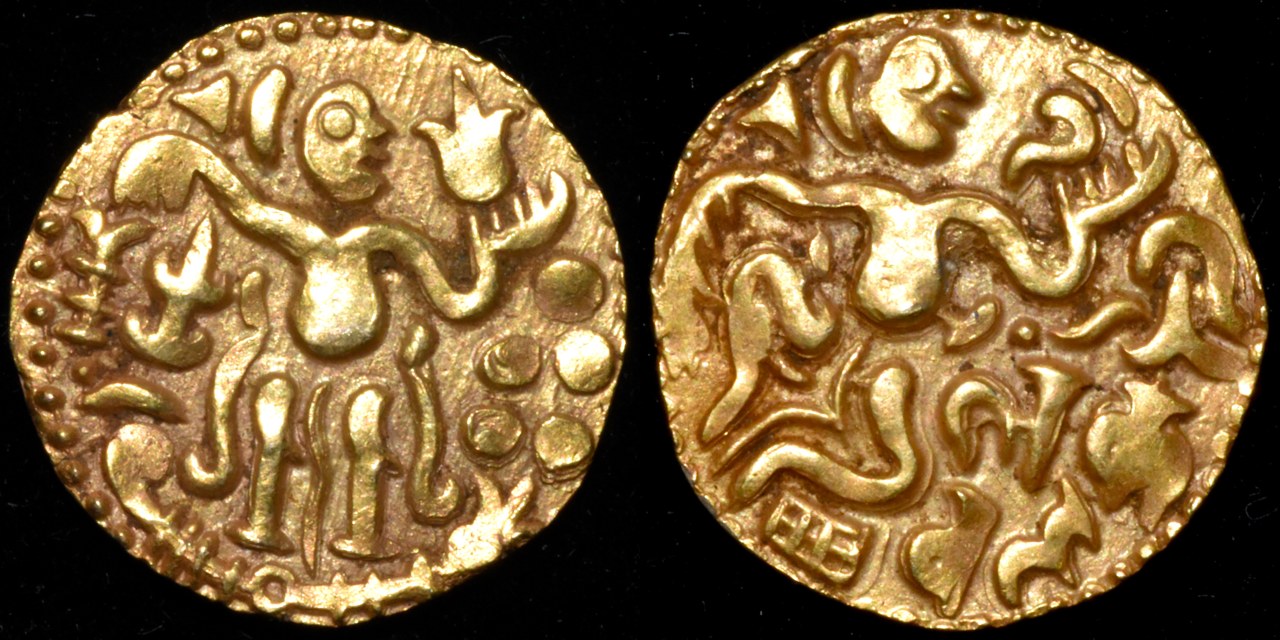

Copper coins usually known as massa carried forward the standing-and-seated imagery. Under Chola rulers and later island kings, inscriptions help identify royal authority. Names encountered include Vijayabahu, Parakramabahu and Queen Lilavati. Even these legends have limits: repeated royal names, and rulers who held power more than once, can make a precise attribution difficult.
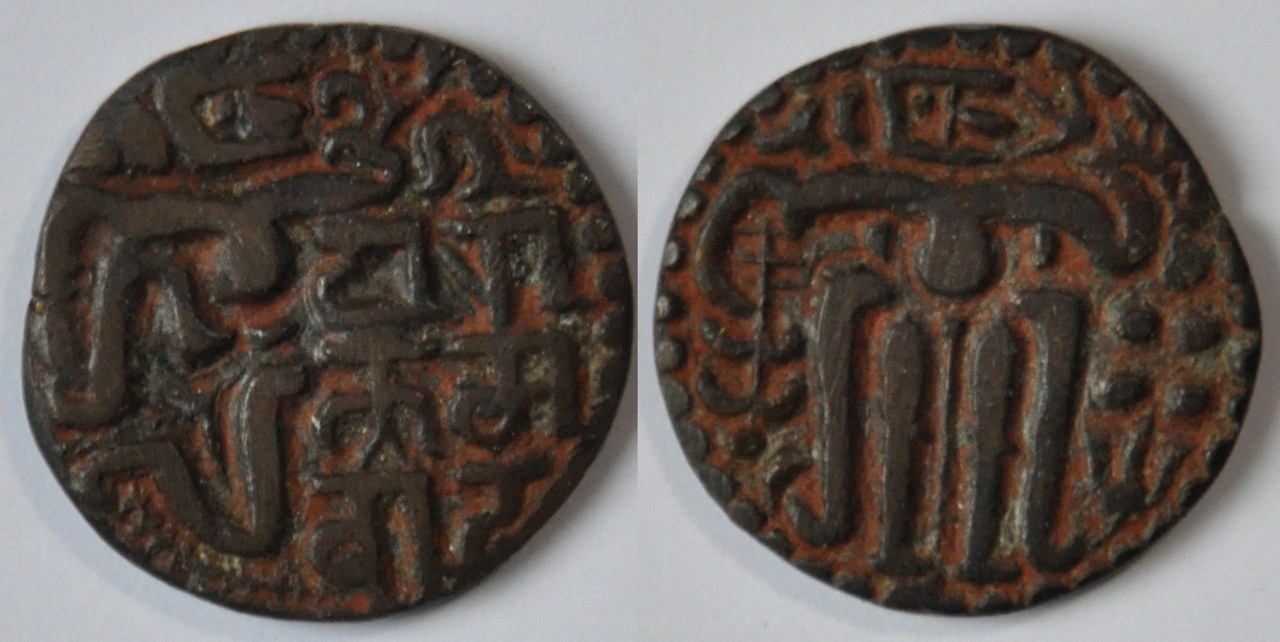

Northern Sri Lanka also has its own monetary history. The setu coins associated with the kingdom of Jaffna show a recumbent bull and adapt elements of the massa tradition. Their existence cautions against describing the island’s past as the work of a single ruler or mint. Metal, inscription and archaeological location together restore the variety that a simple royal chronology can hide.
Later larins—folded and stamped silver wires—point to connections with the Persian Gulf and other Indian Ocean shores. Their hooked shape is instantly recognisable. Accounts of the Kandyan kingdom describe their manufacture and use. They make a useful reminder that accepted money need not look like a round coin at all.
Further reading: CBSL · History of Currency in Sri Lanka
03 / 12
Portuguese ports, Dutch mints and the first paper money
From the sixteenth century, Portuguese coastal power added new issues to an already mixed monetary landscape. Connections with Goa, Portuguese coats of arms, tangas and panams linked maritime settlements to wider trading networks. The interior did not come under the same authority at the same time: the Kandyan kingdom remained an independent participant. Political borders and the circulation of money rarely coincided neatly.
The Dutch completed the removal of the Portuguese from their coastal positions in 1658. The Dutch East India Company, or VOC, brought its own marks and accounting practices. Copper duits, stuivers and accounts expressed in rix-dollars existed alongside other money. Local production, including at Colombo, supplied regional needs. Mint marks and company initials now help distinguish locally made pieces from imported issues.
Paper money appeared in this colonial setting, long before a central bank. On 10 May 1785 the Dutch administration issued its first series of notes, following authorisation in March. Administrative expenditure and pressure on the treasury lay behind this use of written promises to pay. Official signatures supplied an assurance on paper comparable to the marks of authority stamped into metal.
These notes did not establish the Sri Lankan rupee. They mark a different development: paper entering the island’s means of payment. Nor should a rix-dollar used as an accounting unit automatically be equated with a particular silver coin. Historical records may refer to an accounting value, a physical coin handed over, or an official conversion between several kinds of money.
Further reading: CBSL · History of Currency in Sri Lanka
04 / 12
The rupee takes root, and the cent changes counting
Britain took over the Dutch possessions in 1796; the Kandyan Convention of 1815 ended the kingdom’s independence. Early British Ceylon coins nevertheless retained some earlier monetary vocabulary. The illustrated 1815 stiver places George III on one side and an elephant on the other. A transfer of sovereignty could clearly precede a complete change in the money people used.
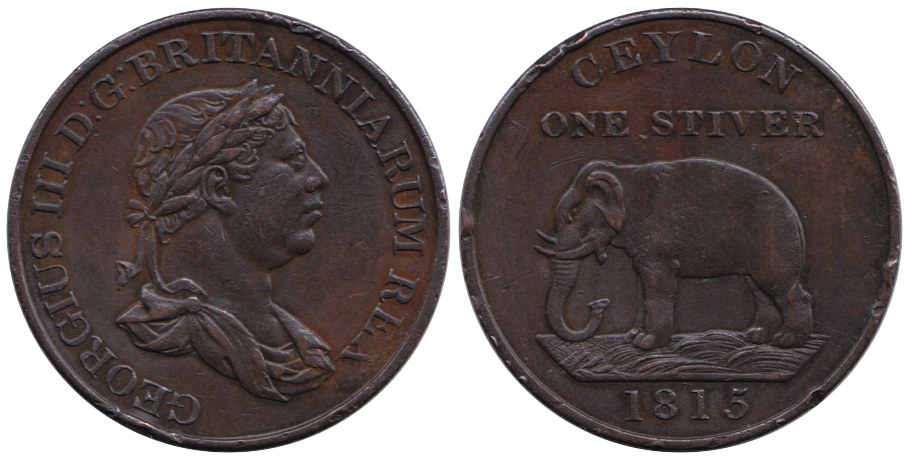

During the nineteenth century, the Indian rupee became increasingly important. Trade with India, plantation finance and the need to pay wages encouraged its use. Workers arriving from southern India, often living and working in harsh conditions, became central to the plantation economy. Money connected export earnings to estate wages and household spending, within a society where access to wealth remained very unequal.
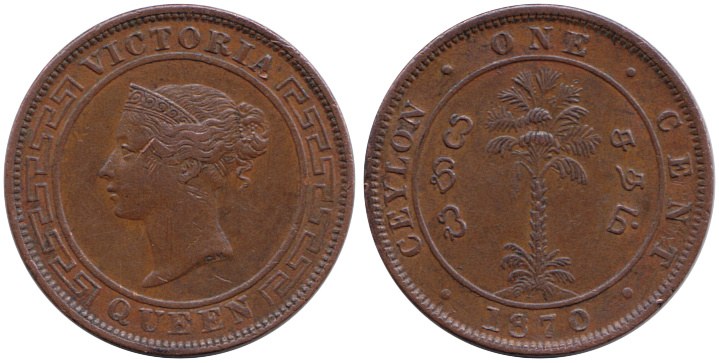

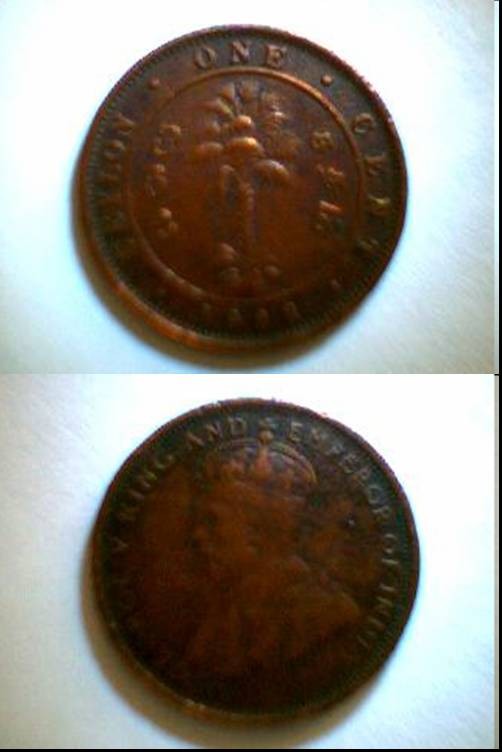
A decisive change was the introduction in 1872 of a Ceylon rupee divided into 100 cents. The earliest decimal coins bear the date 1870: a date on a coin need not be its date of entry into circulation. The illustrated copper cent combines Victoria’s portrait, the name CEYLON, its denomination and local scripts. In a small everyday object, imperial authority meets the practical demands of local exchange.
Ceylon’s system was therefore not simply identical to India’s. Two currencies called rupees may share a history without having the same subdivisions or issuing authority. The story cannot accurately begin with an absolute foundation in 1869, or describe 1950 as a sudden break from money that had previously been exclusively Indian. Monetary change came in successive stages.
Further reading: CBSL · Currency issued by the Central Bank of Sri Lanka, 60th Anniversary Volume · CBSL · History of Currency in Sri Lanka
05 / 12
When coins run short, even cents become notes
For part of the nineteenth century, Treasury paper circulated alongside private banknotes. The bank’s name mattered as much as the denomination: it identified the institution behind the promise to pay. Maritime commerce needed portable large payments, but a variety of issuers also required users to judge whose promise they would accept.

The Paper Currency Ordinance of 1884 established the framework for the Board of Commissioners of Currency, made up of senior colonial officials. Government of Ceylon banknotes therefore long predate independence. A currency-board system links issue closely to reserves and prescribed backing arrangements; it gives its administrators fewer tools than a central bank responsible for credit and banking stability.
The Second World War produced a revealing response to everyday needs: very small notes took the place of scarce coins. Subsidiary issues included 5, 10, 25 and 50 cents. The 5-cent note used impressions of 2-cent and 3-cent postage stamps. This administrative improvisation did not introduce a different currency. It made it possible to give change when small metal coins were difficult to obtain.
At the opposite end of the scale, some high denominations were intended primarily for banking transactions. An old 10,000-rupee note should not be described as ordinary market money or mistaken for a recent innovation. The intended users of an issue are part of its history, just as much as its portrait or its colour.
Further reading: CBSL · History of Currency in Sri Lanka · CBSL · Bank History
06 / 12
1948–1950: building a national institution
Ceylon became independent on 4 February 1948. Two years later, on 28 August 1950, the Central Bank of Ceylon began operations under the Monetary Law Act of 1949. It inherited the currency board’s liabilities and functions while receiving a much wider mandate. This was not the invention of the rupee; it was a change in how the currency was governed.
John Exter played a central part. An American economist from the Federal Reserve Board, he was appointed to prepare the new institution. His report was presented in 1949, and he became its first governor. The bank’s origins should therefore not automatically be attributed to the Bank of England. Independent Ceylon wanted an institution capable of addressing national needs beyond simply backing the banknote issue.
Images did not change at exactly the same pace as laws. Early central-bank series retained George VI and then Elizabeth II. The armorial ensign of Ceylon, a portrait of S. W. R. D. Bandaranaike and an image associated with King Parakramabahu subsequently appeared in the series of the 1950s and 1960s. These choices successively emphasised dominion continuity, state authority and the island’s historical depth.
Further reading: CBSL · Bank History · CBSL · Currency issued by the Central Bank of Sri Lanka, 60th Anniversary Volume
07 / 12
1957–1972: heritage carried in a pocket
In 1957 the central bank issued its first commemorative coins, marking the 2,500th anniversary of the Buddha’s passing into parinirvana. The silver 5-rupee piece, manufactured by Britain’s Royal Mint, surrounds the number 2500 with animals and uses an elaborate plant design around the denomination. Its large surface makes the coin a vehicle for cultural memory, quite unlike a small circulating cent.
The central bank’s catalogue gives the piece a diameter of 38.61 mm and a weight of 28.28 g. A cupronickel 1-rupee issue accompanied it. These are coins of independent Ceylon. The word “British”, sometimes added to a collector’s image filename, does not turn 1957 into part of the colonial period. A British mint was the manufacturer, not the political issuing authority.
In 1963 a regular series, running from one cent to one rupee, replaced royal portraits with Ceylon’s armorial ensign. In 1972 the republic took the name Sri Lanka, and new arms replaced the crown with the Dharma wheel. This did not entail deleting zeros or converting balances into a new unit: the rupee remained the rupee.
The bank’s own name followed a different timetable: Central Bank of Ceylon became Central Bank of Sri Lanka in 1985. Country, currency, inscriptions and institution need not change names on the same day. Sinhala, Tamil and English inscriptions on modern money also contradict the claim that Tamil generally disappeared from banknotes after 1972.
Further reading: CBSL · Commemorative Coins and Notes · CBSL · Currency issued by the Central Bank of Sri Lanka, 60th Anniversary Volume · CBSL · Bank History · CBSL · Current Note Series
08 / 12
From portraits to birds: renewing the national story
Economic changes in the 1970s altered the rupee’s setting. Import and exchange restrictions, followed by the opening begun in 1977, reshaped the connections between external earnings, credit and domestic prices. This history is more complex than an untroubled golden age before 1970 or the instant disappearance of every control after 1977. Monetary institutions adapted their tools through successive reforms.
Banknotes provide a different thread. The 1979 series gave fauna and flora a central role; later series explored archaeology, history, development and heritage. A country could be represented without placing a political leader at the centre of every denomination. A bird, an ancient building or a piece of infrastructure became another way of describing the island.
The civil war, from 1983 to 2009, caused profound human suffering and disrupted communities and economic activity. One event struck the monetary institution directly: the bombing of its Colombo headquarters on 31 January 1996. Employees and members of the public were killed; services resumed from temporary premises. Keeping payments working and preserving records became immediate tasks of institutional continuity.
It would nevertheless be misleading to attribute all advances in note security or electronic payments to the war. Currency technology also evolved within an international printing industry. Coins and notes establish decisions about design and manufacture; they cannot, by themselves, prove a wider political or economic cause.
Further reading: CBSL · Currency issued by the Central Bank of Sri Lanka, 60th Anniversary Volume · CBSL · Bank Headquarters
09 / 12
Reading the notes: bridges, butterflies and dancers
The eleventh series, put into circulation in 2011, combines development, prosperity and Sri Lankan dancers. Its six main denominations, from 20 to 5,000 rupees, share a height of 67 mm and increase progressively in length. Preparation, signature and printing dates should be distinguished from issue dates: official documentation also describes this family as the 2010 series.
On the fronts, modern structures and landscapes appear alongside birds and butterflies. The backs are designed to be read vertically, bringing dancers and musicians together with guard-stones and ornamental plants. The 100-rupee note includes Bharatanatyam and a mridangam player, making a tradition associated with Tamil culture explicitly visible.
These combinations represent the country through infrastructure as well as the arts. The bridge does not displace the musician, and the bird does not replace the building: each note offers several overlapping ways of looking at the island. The table identifies the main subjects of these six notes, rather than claiming to list every older or commemorative issue.
| Value (LKR) | Size (mm) | On the front | On the back |
|---|---|---|---|
| 20 | 128 × 67 | Colombo harbour · Serendib scops owl | Ves Netuma · Geta Bera |
| 50 | 133 × 67 | Manampitiya bridges · dull-blue flycatcher | Vadiga Patuna · Yak Bera |
| 100 | 138 × 67 | Energy and Laxapana · orange-billed babbler | Bharatanatyam · mridangam |
| 500 | 143 × 67 | Colombo and Lankathilake · Layard’s parakeet | Thelme Netuma · Yak Bera |
| 1 000 | 148 × 67 | Ramboda tunnel · Sri Lanka hanging parrot | Malpadaya Netuma · Daul Bera |
| 5 000 | 153 × 67 | Dams · yellow-eared bulbul | Nagaraksha · Guruluraksha |
Further reading: CBSL · Current Note Series · CBSL · Currency issued by the Central Bank of Sri Lanka, 60th Anniversary Volume · CBSL · 2,000 rupees, notice of 15 September 2025
10 / 12
Making a rupee: paper, steel and specialised workshops
The central bank specifies and approves currency characteristics, then commissions specialist manufacturers. Designing a coin, striking it and issuing it are separate operations. A country can exercise its own monetary authority while ordering its coins from a mint abroad.
The central bank’s FAQ identifies De La Rue Lanka at Biyagama as the banknote printer. Ordinary note paper is made from cotton fibres. The commemorative 200-rupee note of 1998, marking fifty years of independence, is a notable exception: it used polymer. Here, the material itself becomes evidence of a technological change.
Coins tell a story of durability and cost. Regular circulating 2- and 5-rupee coins were introduced in 1984. For the family of 1, 2, 5 and 10 rupees distributed from 3 December 2018, stainless steel, size and thickness help provide durability and tactile recognition. The 2017 date associated with the family should not be used to move its circulation launch a year earlier.
Manufacturers vary with procurement contracts. The bank identifies Slovakia’s Mincovňa Kremnica for that series and the China Banknote Printing and Minting Corporation for the 2020 20-rupee coin. These names extend a long history of local, colonial and international workshops. Once commercial banks return used notes, sorting machines distinguish reusable currency from worn notes destined for destruction.
Further reading: CBSL · Currency FAQs · CBSL · Currency Management · CBSL · New circulation coin series, December 2018
11 / 12
2022: a crisis of confidence, without a new currency unit
The 2022 crisis brought the rupee into the centre of daily life. Falling external earnings, fiscal and debt vulnerabilities, the pandemic and policy errors combined. Foreign-currency shortages made fuel, medicine and other essential imports harder to obtain. These difficulties were not experienced only as an exchange-rate quotation: they affected journeys, businesses and household spending.
Rupee depreciation and rising prices reduced purchasing power. Yet no replacement currency unit was introduced during the crisis. A note can retain its printed denomination while buying much less than before. Separating face value, domestic prices and external value avoids confusing inflation, depreciation and a change of currency.
In March 2023 the IMF approved a four-year programme of about US$3 billion, linked to reforms and the restoration of debt sustainability. The Central Bank Act of 2023 also recast the institutional framework, placing domestic price stability first. These are historical milestones; by themselves they promise neither a particular future path nor the same experience for every household.
Further reading: IMF · EFF arrangement, 21 March 2023 · CBSL · Bank History
12 / 12
A currency holding several kinds of memory
New issues also keep history present through commemoration. The 1,000-rupee note for the seventieth anniversary of independence in 2018 adapted the 2011 family with anniversary elements. In August 2025 the central bank issued a circulating commemorative 2,000-rupee note for its seventy-fifth anniversary. A commemorative issue can therefore be intended for payments, rather than solely for a collector’s cabinet.
Conversely, a gold or silver collector coin, or one made to a special finish, may rarely change hands at face value. Precious metal, mintage, presentation and condition then belong to a different story from everyday payment. The word “commemorative” alone does not tell us how an object was used.
From kahapana punches to the dancers on banknotes, the island has repeatedly borrowed, manufactured and reinterpreted monetary signs. The central bank’s Economic History Museum traces these transitions. The continuing thread is neither perfect stability nor an unbroken succession of crises. It is the way a society gives value a recognisable form and renews the institutions that support it.
Further reading: CBSL · 2,000 rupees, notice of 15 September 2025 · CBSL · Commemorative Coins and Notes · CBSL · Economic History Museum
DOCUMENTATION
Sources and credits
Research and text checked on 15 October 2026. Institutional references appear with the relevant chapters; photographs and credits are stored locally.
- CBSL · History of Currency in Sri Lanka
- CBSL · Bank History
- CBSL · Currency issued by the Central Bank of Sri Lanka, 60th Anniversary Volume
- CBSL · Current Note Series
- CBSL · Commemorative Coins and Notes
- CBSL · Economic History Museum
- CBSL · Currency Management
- CBSL · Currency FAQs
- CBSL · Using Bank Note Images
- CBSL · Bank Headquarters
- IMF · EFF arrangement, 21 March 2023
- CBSL · 2,000 rupees, notice of 15 September 2025
- CBSL · New circulation coin series, December 2018
- British Museum · Matara hoard, 1929,1204.18