A king on a worn note, a queen on a half rupee, a president on a coin and a worker beside coconuts: Seychellois cash forms a small archive of the country. Its history began long before independence in 1976. Later came a distinctive idea: making biodiversity a language of money.
Before the rupee: islands on ocean routes
The Seychellois currency story begins with sea crossings. The islands appear in early sixteenth-century European mapping; the first recorded landing dates to 1609. A place on a chart, however, is neither a permanent settlement nor a monetary system. France claimed the islands in 1756, and a lasting colonial society began with settlement on Sainte Anne in 1770.
The settlers came through the world of the Mascarene Islands. They included French colonists, enslaved Africans and people of Indian origin. That diversity, and the profound inequalities of plantation society, belong at the centre of Creole history. An account concerned only with European arrivals would leave out many of the people who built the islands.
Documents assembled in 1909 reveal connections with Isle de France, now Mauritius: provisioning ships, establishing plantations, securing supplies and dealing with colonial administrators. Coin arrived from overseas, like many goods. The evidence consulted here does not establish a precise village-by-village circulation of French livres or Spanish dollars.
Such caution matters. A price might be recorded in one accounting unit, paid with a foreign coin or settled through credit. Monetary history is wider than the history of a name stamped on metal. In Seychelles, maritime exchange long preceded money issued in the archipelago’s own name.
Seychelles National Museum — History of the Seychelles · Library of Congress — Unpublished documents, 1742–1810
1914: from imported cash to local paper
British rule did not begin in a single moment. Wartime seizures and changing control during the Revolutionary and Napoleonic period culminated in formal recognition of British sovereignty in 1814. Administered alongside Mauritius, Seychelles became a separate colony in 1903. Political separation did not instantly remove payment habits developed through inter-island connections.
The rupee belonged to an Indian Ocean monetary geography. A shared name did not mean a single currency across the region: administration, accepted coin and issuing institutions were different things. Mauritian notes preceded Seychelles issues, while the Indian rupee also appeared in the redemption arrangements for the earliest local paper.
In August 1914, the outbreak of the First World War turned supply difficulties into a currency emergency. The ordinance of 10 August authorised notes redeemable in Indian silver rupees, subject to the delay laid down in the arrangement. Krus and Schuler’s compilation of currency-board legislation and accounts identifies these as emergency issues. In 1919, note issue was placed on currency-board lines.
This was a substantial change: a promise issued by the local government could take the place of metal in transactions. It was not yet modern central banking. It nevertheless gave Seychelles its own paper currency decades before the Republic. The significance of 1976 lies in a change of sovereignty, rather than the first appearance of a local rupee.
Seychelles National Museum — History of the Seychelles · Krus & Schuler — Currency Board Financial Statements: Seychelles
1939–1968: reading the colonial period
In 1939, London’s Royal Mint made a distinct Seychelles coin series. Its contemporary report, reproduced by Museums Victoria, explains that Indian silver rupees had been leaving the islands. The new rupee, half rupee and 25-cent coins contained less silver: 500 parts per thousand, against 916⅔ in the corresponding Indian coins. A copper-nickel 10-cent piece completed the series. Reducing the incentive to export the metal was intended to help keep cash locally.
Museums Victoria — 1 Rupee, 1939, NU 14787; Royal Mint Report 1939, p. 7
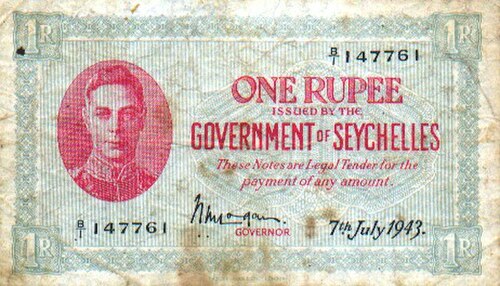

The one-rupee note dated 7 July 1943 makes this history tangible. George VI appears in a medallion, but the issuer is explicitly the Government of Seychelles. Numerals in the corners repeat the denomination written across the centre. Serial number, date and signature identify the object and demonstrate an organised issuing procedure.
The statement establishing the note as legal tender is more than ornament. It expresses the public authority behind the promise. Folds and staining on this worn example also remind us that a banknote was made to pass through people’s hands. They cannot tell us how many purchases it paid for, or the precise purchasing power of a rupee in 1943.
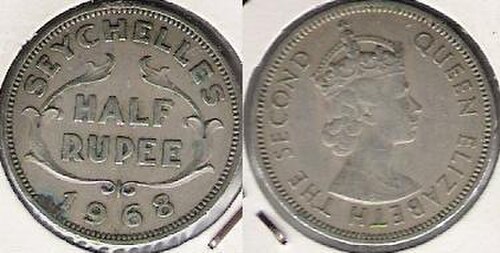

The 1968 half rupee offers a different perspective. Elizabeth II occupies one side; the other combines the Seychelles name, denomination and two birds. Territorial identity sits within an imperial framework. The coin therefore does not fit a simple division between “British” and “local” money: both identities appear on the same object.
The denomination is revealing too. A half rupee means fifty cents: an everyday fraction coexisting with the rupee name. To follow a coin series, a collector must examine denomination, date, portrait and inscriptions together. Metal alone does not explain the political system, while a portrait alone does not identify the issuer.
These photographs are individual witnesses rather than a comprehensive catalogue. They show how colonial currency made both a distant monarch and the territory of circulation visible.
1976–1977: the face of the Republic
Seychelles became independent on 29 June 1976, with James Mancham as the Republic’s first president. The unit remained the rupee, but the representation of authority changed: the new state could place its own president and republican name on its money.
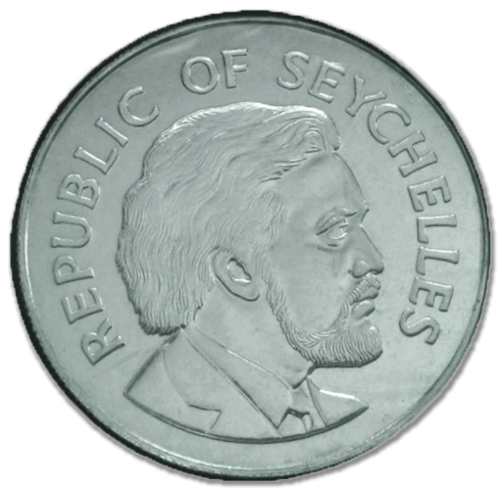

The portrait illustrated here belongs to the 1977 25-rupee coin. Noonans’ catalogue confirms that this Silver Jubilee issue for Elizabeth II appeared early that year. It is a striking combination: an independent republic marked the British monarch’s anniversary while portraying its own president. The coin recorded a continuing relationship with the former colonial power alongside newly acquired sovereignty.
On 5 June 1977, a coup led by France-Albert René overthrew Mancham. Noonans records the new government’s instruction to replace his portrait with the national arms on coinage. It also describes 1977 trial coins retaining his likeness. A trial is part of manufacture or approval; its existence does not establish that the coin reached ordinary circulation.
Such objects require us to distinguish the date on a coin, the time it was manufactured and the date it was issued. Political change may fall between them. A portrait can preserve a moment that lasted only briefly. It would be misleading to imagine every note and coin changing immediately after the coup.
Cash is therefore more than an illustration of political events. Orders, stocks and production schedules form part of the history of transition itself.
1978–1983: building a monetary institution
A local currency, an independent republic and a central bank are different things. The institutional sequence is clear: the Seychelles Currency Board was organised under the 1936 ordinances; arrangements changed in 1974; the Seychelles Monetary Authority opened on 1 December 1978; the Central Bank succeeded it on 1 January 1983.
The currency board primarily connected cash issue with its backing. The Monetary Authority acquired broader monetary and banking-supervision responsibilities. It was a period of institution-building before full central-bank status. In 1979 it was already involved in handling the liquidation of a local bank: protecting confidence meant more than supplying printed money.
On a banknote, the issuer’s name is consequently as useful as a portrait. A signature records responsibility; an institutional title places the issue within an administrative succession. A new title does not automatically mean a new accounting unit or a conversion of prices.
CBS — History of the Bank · CBS — A Brief History of the Central Bank of Seychelles · CBS — Quarterly Review, April–June 2005, pp. XXXIV–XXXVII
1981: everyday work becomes a monetary subject
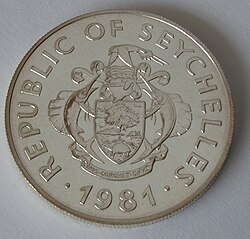
Between presidential portraits and the wildlife of later series, one coin tells another story: food production. A 1981 issue of 100 rupees bears the words World Food Day. FAO had established the observance for 16 October 1981 and annually thereafter.
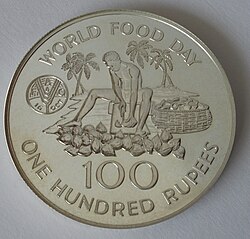


Look closely at the design. A figure processes coconuts, containers organise the scene, and palms locate the activity. This is not an unpeopled beach. Labour is the main subject. Beside the large 100 and English denomination, the FAO emblem connects a local activity to an international programme.
The other side brings together the national arms and the Republic’s name. Coconut palm, tortoise and maritime references provide a compact account of the country. Following individual portraits, a collective emblem offers a different expression of sovereignty. It also supplies a visual link between issues devoted to different subjects.
The contemporary programme sheet attributes manufacture to Britain’s Royal Mint. This illustrates a fundamental distinction: the issuing authority may commission a mint overseas to make its coins. A coin manufactured in Britain for Seychelles remains a Seychellois issue.
A photograph cannot certify silver fineness. Descriptions identify different metal variants, and an alloy should never be inferred from its shine alone. This commemorative issue must also be distinguished from ordinary pocket change. A face value of 100 rupees establishes neither its collector price nor its actual use in daily purchases.
FAO — World Food Day: Council proceedings, 1981 · World Food Day — 1981 numismatic programme, contemporary sheet
2008: changing how the rupee worked
Not every monetary transformation is visible on paper. The same unit and designs may survive a major change in exchange arrangements. On 31 October 2008, President James Michel announced that the rupee would float from 1 November, amid a balance-of-payments and public-debt crisis.
The IMF’s April 2009 report places the decision within a stabilisation programme involving foreign-exchange liberalisation, fiscal adjustment and financial support. The rupee depreciated sharply after the float. This was not a redenomination requiring people to exchange a quantity of old rupees for one new rupee. The unit remained; the way its external value was determined changed.
The practical consequences can be understood without quoting an obsolete exchange rate. When the national currency loses value against the currency used to pay for imports, imported goods may become more expensive in rupees. Access to foreign currency and the organisation of external transactions also change. The effects differ according to people’s earnings, spending and activities.
The return to multiparty politics in 1993 and foreign-exchange liberalisation therefore belong to different chronologies. Political and monetary turning points do not necessarily share a timetable. November 2008 changed how the rupee worked, while its name and subdivisions remained familiar to the public.
James Michel — Address to the nation, 31 October 2008 · IMF — Seychelles, Country Report 09/121, April 2009
2016: a living archipelago on banknotes
A new family of notes and coins entered circulation on 5 December 2016. Prepared for the fortieth anniversary of independence, it used biodiversity as its organising theme. The Central Bank explained that the project, begun in 2012, combined stronger protection, features for people with visual impairments and the country’s trilingual heritage.
The cultural significance goes beyond attractive wildlife. Birds, plants and their habitats can represent the country without limiting its identity to one person or building. Scientific names distinguish a Seychellois species from a generic tropical outline. A banknote becomes a way of recognising the living environment.
| Value | Bird on the front | Dimensions |
|---|---|---|
| 25 rupees | Seychelles magpie robin | 126 × 63 mm |
| 50 rupees | Seychelles black parrot | 132 × 66 mm |
| 100 rupees | Seychelles black paradise flycatcher | 138 × 69 mm |
| 500 rupees | Seychelles kestrel | 144 × 72 mm |
Dimensions increase with value, a choice serving more than composition. Size differences and tactile markings help people distinguish denominations. Colour, numerals and touch contribute to the same aim: recognising a note without relying on one clue.
De La Rue states that it worked with the Central Bank on integrated designs for all four notes. Its 2017 report identifies holograms and different security threads. The technical detail has a place in the story: wildlife is not simply decoration beside the security features, but part of the object’s visual organisation.
The 2016 family is a historical milestone, rather than a complete inventory of subsequent printings. The 2025 annual report describes an updated 500-rupee note, for example. Identifying an individual specimen therefore requires comparison with the issuer’s documentation.
CBS — Current Family of Notes and Coins · CBS — New family of banknotes and coins, 3 November 2016 · CBS — Seychelles’ New Family of Banknotes and Coins, 2016 · De La Rue — Annual Report 2017, Cash Supply Chain · CBS — Annual Report 2025, Currency and Numismatics
From paper to metal: manufacturing for the islands
The 2016 redesign introduced a bimetallic 10-rupee coin to replace the note of the same value. Its seven-lobed outline and contrasting colours distinguish it from smaller denominations. An Aldabra giant tortoise continues the wildlife theme. In everyday handling, outline, diameter and colour also help people recognise values.
Metal must withstand real conditions. In January 2018, a Central Bank announcement reported by Seychelles Nation described a replacement composition for the 10-rupee coin after accelerated tarnishing and corrosion had been observed. The supplier was the Royal Mint. The revised composition was intended to cope better with the Seychellois climate.
This material history is revealing. Manufacturing decisions must combine durability, readable relief, recognisable denominations, counterfeit protection and production cost. A coin may look successful in a presentation and still need improvement after use.
Smaller denominations tell a story of continuity. The CBS states that the coin family introduced in 1982 continues alongside the newer series. A change of design does not automatically remove every older date. Earlier banknotes followed a different withdrawal timetable: the Bank’s documentation identifies demonetised issues.
The roles must remain distinct. The Central Bank commissions and issues money; printers and mints manufacture it; banks make cash available to the public. Confusing those functions would imply that overseas manufacture diminishes a currency’s national identity. The rupee instead demonstrates sovereignty exercised through specialist collaboration.
CBS — Seychelles’ New Family of Banknotes and Coins, 2016 · Seychelles Nation — New R10 coin to replace current one, 31 January 2018 · CBS — Previous Coins · CBS — Previous Notes
What a handful of rupees preserves
Placing the 1943 note beside the 1968 half rupee, Mancham’s portrait and the 1981 national arms reveals several ways to represent authority. Monarch, president and national emblem do not follow one another as neatly as textbook illustrations. Objects circulate, survive and enter collections beyond the moment in which they were made.
The 2016 family adds another idea: a country can recognise itself through species found only on its islands. Landscapes and living things join institutional names and portraits within monetary memory. Iconography alone cannot measure prosperity or establish the success of economic policy. It shows what an issuer chooses to make visible.
The rupee divides into one hundred cents and carries the code SCR. The CBS lists four note values — 25, 50, 100 and 500 rupees — and seven coin values — 1, 5, 10 and 25 cents, followed by 1, 5 and 10 rupees. A commemorative coin may carry another denomination without becoming ordinary pocket money.
Numismatic observation starts with simple questions: who issued it, when, for what value, and with what design? Is it a circulation coin, a commemorative or a trial? That method prevents an attractive image from becoming evidence for something it cannot establish. It also lets us appreciate wear as a material trace without inventing an individual history for the object.
In Seychelles, the rupee name connects different histories: Indian Ocean circulation, colonial paper, the making of the Republic and the celebration of a natural heritage. Each object retains part of that story. Reading them together restores the island currency’s historical depth.
Sources and credits
Research checked on 15 October 2026. Institutional sources, contemporary documents and direct observation of the illustrated objects.
- Museums Victoria — 1 Rupee, 1939, NU 14787; Royal Mint Report 1939, p. 7
- Seychelles National Museum — History of the Seychelles
- Library of Congress — Unpublished documents, 1742–1810
- Krus & Schuler — Currency Board Financial Statements: Seychelles
- CBS — History of the Bank
- CBS — A Brief History of the Central Bank of Seychelles
- CBS — Quarterly Review, April–June 2005, pp. XXXIV–XXXVII
- Noonans — Catalogue, 16 March 2017, lot 1379
- FAO — World Food Day: Council proceedings, 1981
- World Food Day — 1981 numismatic programme, contemporary sheet
- IMF — Seychelles, Country Report 09/121, April 2009
- James Michel — Address to the nation, 31 October 2008
- CBS — New family of banknotes and coins, 3 November 2016
- CBS — Current Family of Notes and Coins
- CBS — Seychelles’ New Family of Banknotes and Coins, 2016
- De La Rue — Annual Report 2017, Cash Supply Chain
- Seychelles Nation — New R10 coin to replace current one, 31 January 2018
- CBS — Notes and Coins
- CBS — Previous Notes
- CBS — Previous Coins
- CBS — Annual Report 2016, Currency and Numismatics
- CBS — Annual Report 2025, Currency and Numismatics
The photographs document issues from 1943 to 1981. Recent types are described using CBS documentation; reproductions are omitted where rights in the currency artwork have not been established. Credits and licences are recorded in the manifest. Text and images work offline; reference links require an Internet connection.