From shells accepted in exchange to a craftsman’s hands on a 500 rufiyaa note, money tells the story of Maldivian connections and knowledge.
When lagoons supplied money to the world
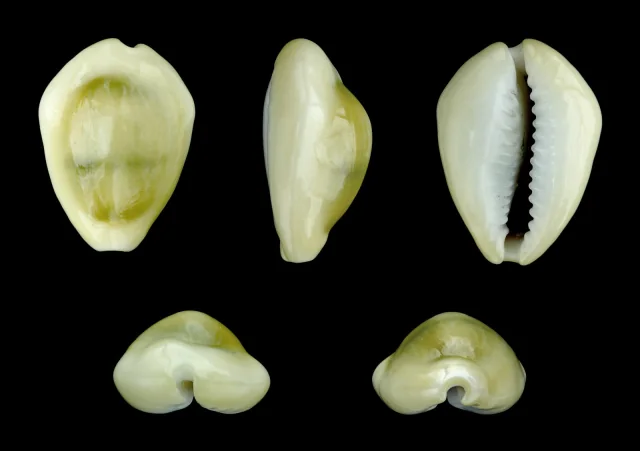
Long before paper money, the Maldives exported a monetary material that required no mint: the cowrie shell. Small shells, particularly Monetaria moneta, were durable, portable and recognisable. Their value did not depend on precious metal, but on other people accepting them in payment. They offer an unusually clear introduction to monetary history: communities could count, save and trade with objects quite different from the coins familiar today.
Medieval accounts and research into Indian Ocean exchange place the Maldives at the heart of a substantial shell trade. In the fourteenth century, Ibn Battuta described cowries being shipped to Bengal, where they served as currency and helped obtain rice. The islands were connected to major maritime routes through the very resources found in their lagoons.

Counting shells, carrying value
A large payment created a practical difficulty: thousands of small units had to be counted, gathered and transported. Nor did local abundance give shells an identical value everywhere. Shipping costs, regional habits and available supplies helped determine their purchasing power. There was no single, permanent cowrie exchange rate across the world.
The networks changed over time. Indian Ocean cowries also reached West Africa, where their early modern trade became connected with the trafficking and enslavement of people. That history cannot be told solely as a cheerful commercial adventure. An object used for ordinary purchases could also be drawn into coercive systems. Within the Maldives, the balance between shells and silver likewise varied: researchers do not assign cowries exactly the same domestic role in every period.
British Museum · Maldivian money cowries · Stringing Together Cowrie Shells · archaeological study, 2021 · King tuna · history of Indian Ocean trade, 2020
The larin: from bent silver to the sultan’s coins
In the early seventeenth century, a French observer encountered a different kind of money. François Pyrard, who stayed in the Maldives after being shipwrecked in 1602, described silver larins: short lengths of bent wire stamped with a ruler’s name. The larin belonged to a trading currency family associated with the Persian Gulf and used around the Arabian Sea. Recognisable money did not have to be round.
Pyrard’s account is particularly valuable for its practical details. Silver was weighed and tested; pieces could be cut to provide smaller amounts. Trust rested on both the stamp and the metal. Yet a traveller’s description is not a substitute for examining surviving objects. Numismatists continue to question the Maldivian attribution of some hairpin-shaped larins.

A circular coin inherits the larin’s name
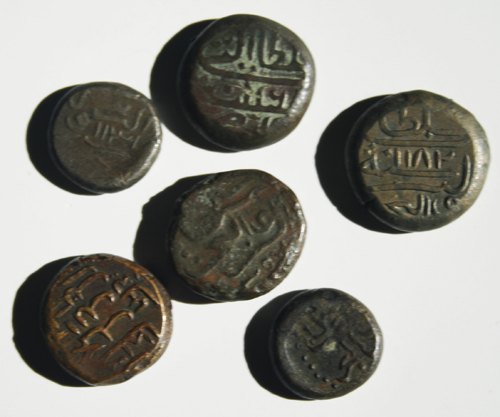
The beginnings of circular coinage are generally placed in the reign of Ibrahim Iskandar I, who ruled from 1648 to 1687. The old name survived the change in shape. Early silver issues were followed, in different periods, by less valuable alloys and copper or bronze coins. Their history distinguishes the name of a unit from its metal content and actual purchasing power.
Arabic inscriptions expressed the sultan’s authority. They do not establish that a regular local dinar-and-dirham system began immediately with the kingdom’s conversion to Islam in the twelfth century. Thaana, the script used for Dhivehi, is also distinct from the Arabic alphabet. Religious history, language and money intersect, but should not be collapsed into a single story.
Oriental Numismatic Society · François Pyrard’s account, no 89 · Raf Van Laere · Circular Coinage of the Maldive Islands, 1979 · Oriental Numismatic Society · numismatic research and discussion, no 249, 2022
Local coinage and the Ceylon rupee
For a long period, the sultanate’s coins remained workshop products: prepared blanks, engraved dies and strikes whose irregularities are now part of their historical interest. Wear and incomplete inscriptions can make identification difficult. A photograph of several pieces cannot securely assign a date to every object.
At the beginning of the twentieth century, the sultanate’s last coin issues still reflected adjustments in weight and denomination. Numismatic research discusses one- and four-larin pieces in particular. The continued use of a name does not imply a fixed equivalence between all the coins that bore it over several centuries.
Money arriving through trade
Commercial connections with Ceylon, now Sri Lanka, gave its rupee a significant role. Imported coins and notes travelled through merchant networks; the Maldivian monetary system did not develop in isolation. The word rufiyaa belongs to the same linguistic history as “rupee”, while laari preserves the memory of the larin.
The British protectorate established in 1887 should not be equated with the same form of colonial administration as British India. Foreign currency circulation must also be distinguished from national issuance. The MMA records that sterling and Sri Lankan rupee notes were among the first paper currencies used during the early 1940s: familiarity with paper money preceded the first Maldivian banknotes.
Oriental Numismatic Society · early twentieth-century coins, no 207 · MMA · History of MMA / Issuance of Currency
1947–1948: the first national banknotes
Two dates are often compressed into the label “1947 series”. The MMA’s historical account states that Parliament approved legislation for the rufiyaa as the national legal tender in August 1947; the first notes then entered circulation in September 1948. A date printed on a banknote, the name of its series and the moment the public could spend it need not coincide.
The first denominations were ½, 1, 2, 5 and 10 rufiyaa. Notes of 50 and 100 joined the family in 1951. The half-rufiyaa demonstrates that paper initially served relatively small transactions: today’s division between coins and banknotes should not be projected backwards. The issuing authority was the government, decades before the establishment of the central bank.
View the object in the source linked below.

A country pictured through its boats
Palms, vessels and views of Malé created a familiar geography across the first banknote family. Buildings and waterfront structures are records of the capital as well as decorative subjects. Paper money carried a shared image of the country between islands separated by sea.
These notes originated under the sultanate, before political independence in 1965 and the republic established in 1968. They should not be described as the outcome of Maldivian independence in 1947. The national paper currency continued through changes of government before being replaced by a new family in 1983. Its history of later printings therefore extends well beyond the initial series date.
MMA · History of MMA / Issuance of Currency · MMA · An Analysis of the Denomination Structure of the Maldivian Rufiyaa, 2016 · MMA · Withdrawn Banknotes
1981–1983: a monetary authority and a new family
The establishment of the Maldives Monetary Authority in 1981 provided a specialised institution to perform central banking functions. It assumed responsibility for issuing and supplying currency. This institutional change did not create a new rufiyaa worth a different number of old units: it was neither a removal of zeros nor a new unit of account.
The 1 rufiyaa coin entered circulation on 22 January 1983. On 7 October that year, a new banknote family was introduced, initially comprising 2, 5, 10, 20, 50 and 100 rufiyaa. The 20 rufiyaa denomination expanded payment options, while a coin took over the role of the 1 rufiyaa note in repeated everyday handling.
View the object in the source linked below.

Institutional change and public trust
Paper quality, a security thread and a watermark were among the improvements highlighted by the MMA. Modernisation did not completely replace the currency’s visual language: coconuts and a traditional dhivehi odi sailing vessel linked the obverses through a shared composition.
The institution itself also evolved. Until the 2007 reform, the minister responsible for finance served as governor by virtue of that office. The amendment separated the two responsibilities. This chronology prevents the central bank of 1981 from being retrospectively assigned exactly the same institutional arrangements as those developed later.
MMA · History of MMA / Issuance of Currency · MMA · An Analysis of the Denomination Structure of the Maldivian Rufiyaa, 2016
The 1983 reverses: a record of island life
Turning the notes over opens a route through the islands. The 5 rufiyaa note shows a beach, the 10 depicts island life and the 20 presents Malé’s inner harbour. On the 50, the capital’s bazaar makes everyday commerce visible. The 100 honours Medhuziyaarai, a place of religious and historical remembrance.
The 500 rufiyaa note, added in 1990, depicts the Islamic Centre and its mosque. It was not part of the original 1983 group, although catalogues place it within the same family. In 1995, a 2 rufiyaa coin took over from the issuance of the equivalent note. The denomination structure changed gradually rather than through one all-encompassing reform.
View the object in the source linked below.

Reading a banknote as an archive
Design, signature and date need to be considered together. A note printed in 2000 can retain a design first used in 1983; its date does not mark the birth of the whole series. The examples described here make that graphic continuity especially clear.
The family differs from a gallery of political leaders. It foregrounds vessels, plants, workplaces and monuments. That reading is an interpretation of the images chosen, not evidence that economic and social conditions remained unchanged throughout the notes’ circulation.
Laari and rufiyaa: money made to last
The decimal system divides one rufiyaa into one hundred laari. Modern small-denomination coinage complemented banknotes from the 1950s. The MMA’s denomination table for 1954 lists 1, 2, 5, 10, 25 and 50 laari, allowing fractions of a rufiyaa to be made up without relying on numerous small paper notes.
Moving the 1 rufiyaa denomination from paper to coin in 1983, followed by the 2 rufiyaa in 1995, changed the durability of those values. It did not change their amount. A coin and a note can represent the same unit while meeting different practical needs.

Two shells, two histories
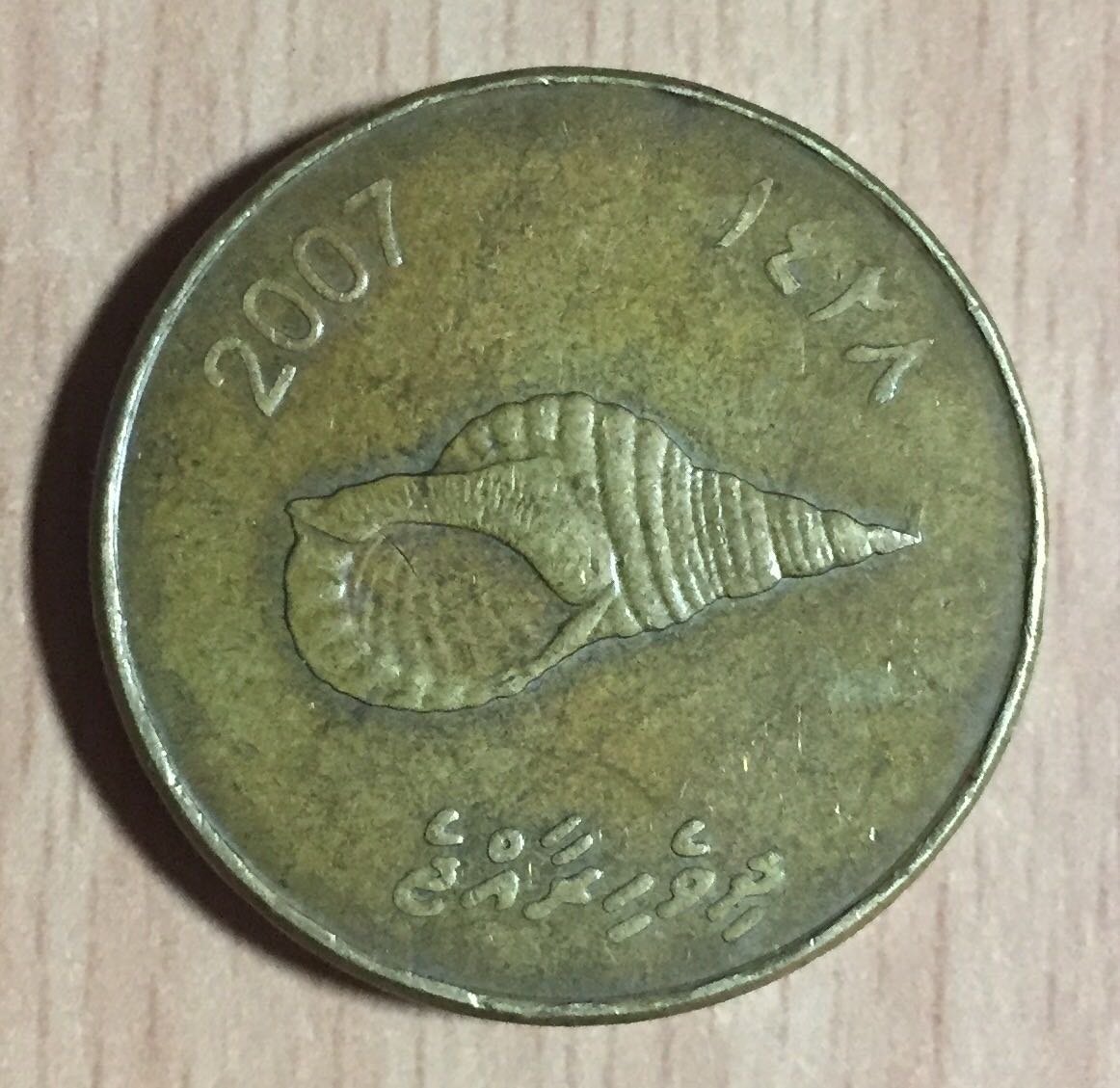
The conch on the 2 rufiyaa coins is much larger than a cowrie. Its symbolism includes communal communication: blowing the shell was a way to summon people. Recognising the difference avoids treating the modern motif as a direct picture of the former shell currency.
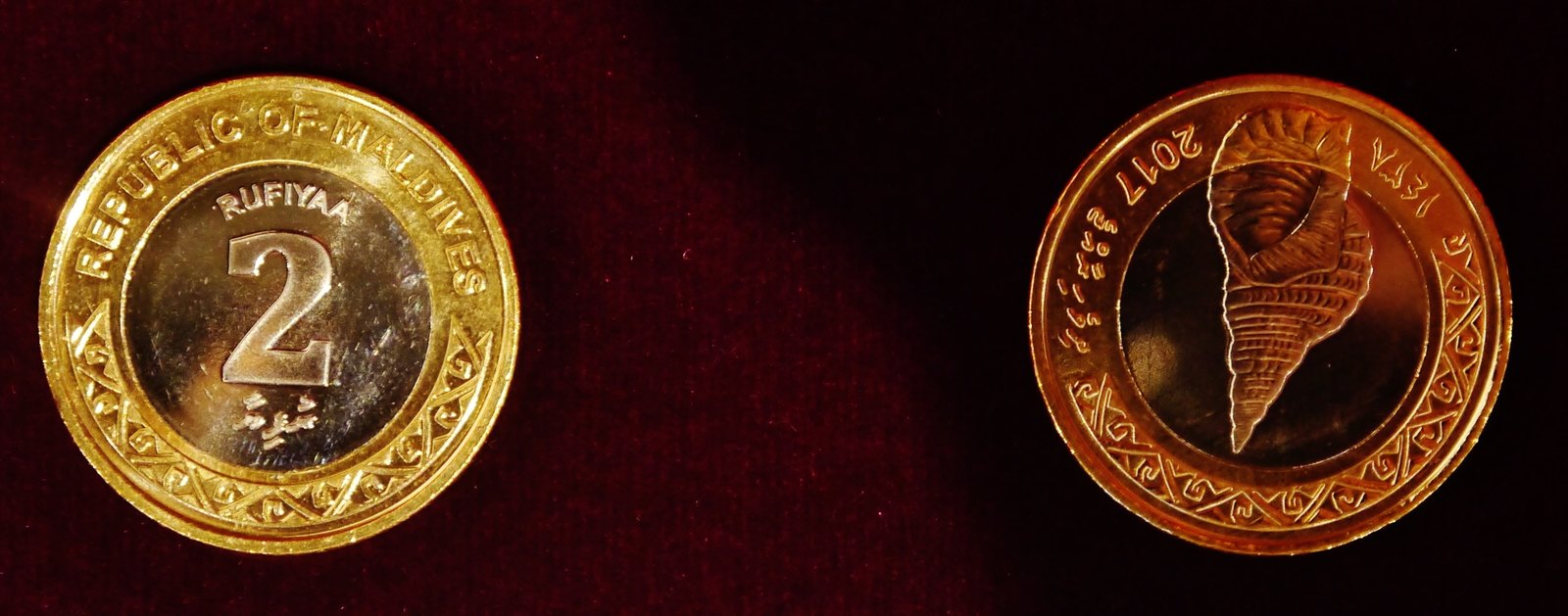

The bimetallic coin dated 2017 retains the conch while changing the object’s construction. Comparison with the 2007 coin shows the move from a visually uniform surface to two contrasting metals. The MMA documents eight coin denominations in circulation: 1, 2, 5, 10, 25 and 50 laari, followed by 1 and 2 rufiyaa. This does not mean every small coin is equally common in payments. Issuance, legal tender status and everyday use are different questions.
MMA · An Analysis of the Denomination Structure of the Maldivian Rufiyaa, 2016 · MMA · Currency in Circulation
2015–2017: the move to polymer
The fiftieth anniversary of independence in 2015 provided a commemorative setting for another major step. The Ran Dhihafaheh family was unveiled on 1 November 2015. Its 10, 20, 50, 100, 500 and 1,000 rufiyaa notes entered circulation on 26 January 2016. The 1,000 extended the range upwards.
The change was physical as well as visual: polymer replaced paper. The MMA highlights moisture resistance and durability, practical considerations for cash circulating in a maritime country. A transparent window became part of the design itself. The note had to be recognisable by touch and against light while retaining a distinctive national appearance.
View the object in the source linked below.

From original artwork to security printing
Competition winner Abdullah Nashaath’s design was developed with De La Rue’s teams. The printer describes how original paintings were transformed into complex designs integrated with its SAFEGUARD substrate. Contemporary banknote production is collaborative: Maldivian cultural design and specialist security printing have distinct roles.
A 5 rufiyaa denomination was subsequently added. The MMA distinguishes its presentation on 10 May 2017 from its entry into circulation on 10 August 2017. Retaining a small denomination as a note illustrates that a currency range is not determined by production economics alone: established ways of using money matter too.
MMA · Ran Dhihafaheh : concepts and chronology · MMA · Handling Polymer Banknotes · De La Rue · collaboration with Abdullah Nashaath and SAFEGUARD substrate · MMA · Currency in Circulation
Seven denominations, a collective portrait of the Maldives
The theme of Ran Dhihafaheh is “Maldives and the Maldivian people”. Its distinctive approach is to picture actions, knowledge and objects alongside places. People play, fish, carve wood, sew and pass on traditions. The currency becomes a small museum carried in a pocket.
| Value | Main colour | Obverse and reverse: key subjects |
|---|---|---|
| 5 | Grey | Football and celebrations; a conch representing communication. |
| 10 | Golden yellow | A palm climber and music; a boduberu drum. |
| 20 | Purple | A fisherman carrying tuna and air transport; a traditional dhoani sailing boat. |
| 50 | Green | Quran recitation and launching a boat; the Friday Mosque minaret. |
| 100 | Red | Working on traditional dress; inscribed copper plates, or loamaafaanu. |
| 500 | Orange | Wood carving and preparing palm ribs; a traditional lacquered naalhi vessel. |
| 1,000 | Blue | A turtle and manta rays; a whale shark. |
A window onto skills and scripts
The 100 links clothing and language: precise textile work is paired with the preservation of writing on copper. Those plates are written documents, not coins. The 500 connects a carver’s action with a lacquered object, honouring an inherited skill rather than an anonymous industrial product.
The 1,000 extends the collective portrait beneath the sea. Its whale shark does not turn the whole family into a tourism catalogue; it complements human, religious and craft subjects. All seven denominations measure 150 × 70 mm, making their colours and designs particularly important for distinguishing them.
MMA · Ran Dhihafaheh : concepts and chronology · MMA · Currency in Circulation · MMA · banknote features and security
Recognition, replacement and commemoration
Security is part of the banknote’s everyday experience. The MMA recommends feeling, looking and tilting. Raised dots help people with impaired vision distinguish denominations. Numbers appear in the clear window; letters become visible against light, while iridescent patterns respond to movement. The 100, 500 and 1,000 also have a changing metallic ink effect.
Withdrawing paper is a separate operation
The arrival of polymer did not immediately remove every older note. The affected paper denominations, apart from the 5 rufiyaa, ceased to be legal tender on 1 August 2016. The paper 5 remained usable until the end of 2017, losing that status on 1 January 2018. Historical MMA exchange deadlines should not be read as a promise of redemption today.
Three questions matter to the holder: identifying the note, establishing whether it remains legal tender, and checking whether its issuer still redeems it. A collector’s object can retain considerable documentary interest after it has ceased to be spendable money.
The anniversary 5,000
The 5,000 rufiyaa commemorative note of 2015 has a different role from the seven ordinary denominations. The MMA dedicated it to the fiftieth anniversary of independence on 26 July 1965. Views of Malé at different dates express the country’s development, while the independence ceremony supplies the subject of the other face. A face value alone does not make it an everyday shopping denomination.
A further visual statement followed in July 2022, when the MMA presented a currency symbol designed by Hassan Shujau. It takes the Thaana letter ra, the initial of rufiyaa, and adds a parallel line. The Latin abbreviation Rf and the code MVR remain useful ways of naming the currency in an international text.
MMA · banknote features and security · MMA · Withdrawn Banknotes · Presidency of the Maldives · withdrawal of old banknotes, 2016 · MMA · Numismatic Currency · MMA · Currency Symbol, 3 July 2022
From shells to transparent windows
This is not the story of one unchanged currency surviving since the cowries. Objects, units, issuing authorities and production techniques have all changed. The strongest link between the periods is the sea: it supplied shells, carried cargoes, connected workshops and ports, and remained visible in banknote imagery.
The rufiyaa also preserves two monetary memories in its vocabulary: the rupee and, through the laari, the larin. Its modern history begins neither with political independence in 1947 nor with a new unit in 1981. It developed through successive decisions, issues, institutions and redesigned objects.
- 14th centuryIbn Battuta describes cowrie trade with Bengal.
- 1602–1607Pyrard stays in the islands; his account describes larins.
- 1648–1687Reign of Ibrahim Iskandar I; circular coinage is generally placed here.
- 1947 / 1948Parliamentary decision, followed by banknote circulation in September 1948.
- 1951 / 195450 and 100 rufiyaa notes added; modern coin range documented in 1954.
- 1981 / 1983MMA established; 1 rufiyaa coin and second banknote family in 1983.
- 1990 / 1995500 rufiyaa note; later, a 2 rufiyaa coin.
- 2015 / 2016Ran Dhihafaheh unveiled; circulation begins on 26 January 2016.
- 2017 / 2018Polymer 5 added; paper 5 ceases to be legal tender on 1 January 2018.
- 2022Currency symbol based on the letter ra introduced.
Sources and credits
Sources checked on 15 October 2026. Some MMA pages use an application interface: links open the relevant section. Each photograph carries its original source and licence. Local images have been resized and compressed without cropping.
The MMA’s detailed chronology distinguishes 1947, the decision and series name, from circulation in September 1948. Some sales descriptions use “1947” alone; this article follows the explicit chronology. Disputed early attributions are identified. Denominations and designs describe issue families, not a guarantee of the validity of every individual note.
- British Museum · cowrie currency from the Maldives
- Stringing Together Cowrie Shells · archaeological study, 2021
- King tuna · Indian Ocean trade history, 2020
- Oriental Numismatic Society · account by François Pyrard, no 89
- Raf Van Laere · Circular Coinage of the Maldive Islands, 1979
- Oriental Numismatic Society · numismatic research and discussion, no 249, 2022
- Oriental Numismatic Society · early twentieth-century coinage, no 207
- MMA · History of MMA / Issuance of Currency
- MMA · An Analysis of the Denomination Structure of the Maldivian Rufiyaa, 2016
- MMA · Withdrawn Banknotes
- MMA · Ran Dhihafaheh : concepts and chronology
- MMA · banknote features and security
- MMA · Currency in Circulation
- MMA · Handling Polymer Banknotes
- MMA · Numismatic Currency
- MMA · Currency Symbol, 3 July 2022
- Maldives Presidency · withdrawal of paper notes, 2016
- De La Rue · collaboration with Abdullah Nashaath and SAFEGUARD substrate
- MMA · Using Images of Banknotes and Coins
Photographic credits
- assets/cauri-moneta.jpg: H. Zell · CC BY-SA 3.0.
- assets/monnaies-sultanat.jpg: A robustus · CC BY-SA 3.0.
- assets/premiere-serie-musee.jpg: Zairon · CC BY-SA 4.0.
- assets/billets-papier-rectos.jpg: Jolle~commonswiki (attribution given by Commons) · CC BY-SA 3.0.
- assets/billets-papier-versos.jpg: Jolle~commonswiki (attribution given by Commons) · CC BY-SA 3.0.
- assets/deux-rufiyaas-2007.jpg: Prabhupuducherry · CC BY-SA 4.0.
- assets/deux-rufiyaas-2017-musee.jpg: Zairon · CC BY-SA 4.0.
- assets/cinq-cents-polymer.jpg: Saaremees (Andres Larin) · CC BY-SA 4.0.
The text, illustrations and navigation work offline. External reference links require an Internet connection.